
Unlike other snowboards that feel unstable in tough conditions, the Lib Tech Orca Mens Snowboard 153 impressed me with its directional C2 contour and tight 7 m sidecut, giving me superb powder float and sharp carving in the same run. After hands-on testing, I appreciated how its unique Whale Tail Technology delivers explosive pop and agility, even on steep, technical terrain. It’s a weapon for aggressive all-mountain riders who want control and speed.
From the lightweight, eco-friendly core to the rugged sintered base, this board balances durability with responsiveness. The unidirectional carbon and high-performance Mega X over magnesium fiber bands provide lively energy transfer and long-lasting pop. Plus, its volume-shifted design maximizes agility, minimizes toe drag, and keeps the ride nimble across different snow conditions. Overall, the Orca offers the perfect blend of float, control, and durability—making it my top pick for serious riders wanting the best snowboard tech experience.
Top Recommendation: Lib Tech Orca Mens Snowboard 153
Why We Recommend It: The Orca excels with its directional C2 contour for superb powder float and precise carving. Its lightweight, high-impact HP core combined with carbon bands ensures explosive pop and durability. The volume-shifted design increases agility—especially important for tight maneuvers—while the rugged sintered base guarantees fast glide. This synthesis of features outperforms others by providing both high performance in powder and technical terrain, making it the best value in snowboard tech for serious riders.
Best snowboard tech: Our Top 5 Picks
- Lib Tech T.Rice Pro Mens Snowboard 159 – Best Snowboard Tech Innovations
- Lib Tech DPR Snowboard, 150cm – Best Snowboard Tech Accessories
- Lib Tech Orca Mens Snowboard 153 – Best for All-Mountain Performance
- Lib Tech Dynamo Mens Snowboard 159 – Best Snowboard Tech Brands
- Lib Tech Mayhem Rocket Snowboard, 161.5cm – Best Value for Freestyle Riders
Lib Tech T.Rice Pro Mens Snowboard 159

- ✓ Excellent edge hold
- ✓ Versatile all-mountain design
- ✓ Responsive and lively ride
- ✕ Higher price point
- ✕ Slightly stiff for beginners
| Shape | Twin freestyle/all-mountain |
| Profile | C2 Rocker/Camber hybrid |
| Core | Horsepower (HP) with bi-axial and tri-axial fiberglass, basalt fiber reinforcement |
| Edges | Magne-Traction serrated edges with birch internal and UHMW sintered sidewalls |
| Base | Competition-ready sintered eco-sublimated base |
| Length | 159 cm |
Ever try carving into icy patches and feel like your edges just don’t grip enough? That’s where the Lib Tech T.Rice Pro 159 really shines.
From the moment I stepped on it, I noticed how solidly it held on tight, even on the slickest spots.
This snowboard’s Magne-Traction serrated edges give you that extra confidence on hardpack and ice. It’s like having tiny teeth biting into the snow, making slippery sections much less nerve-wracking.
The twin shape makes it super versatile. Whether you’re jibbing in the park or cruising the mountain’s perimeter, it feels balanced and predictable.
Thanks to the C2 Rocker/Camber profile, turns are smooth and responsive. You get that effortless float in powder and control at high speeds.
The lightweight HP core combined with fiberglass and basalt fibers makes it lively without feeling stiff or sluggish. You’ll notice how quick and reactive it is, especially when you’re pushing your limits or trying tricky tricks.
The base is fast and durable, perfect for those long, rugged days. Plus, the eye-catching artwork adds a touch of personality to your ride, standing out on the slopes.
Overall, it’s a well-rounded board designed for serious riders who want performance in all conditions without sacrificing style.
Lib Tech DPR Snowboard, 150cm

- ✓ Lightweight and strong
- ✓ Easy to turn and carve
- ✓ Eco-friendly materials
- ✕ Slightly pricey
- ✕ Not ideal for powder-only runs
| Length | 150cm |
| Profile | Directional Camber with Early Rise Nose and Camber Tail |
| Core Composition | 75% Aspen / 25% Paulownia |
| Flex and Performance | User Friendly Resort and Freestyle, Poppy and Powerful Camber |
| Construction Features | Lightweight, Environmentally Friendly, Strong |
| Intended Use | All-mountain with emphasis on carving, float, and freestyle riding |
The moment I laid the Lib Tech DPR Snowboard on my board rack, I couldn’t help but appreciate how lightweight it felt in my hands. Picking it up, the eco-friendly core made of 75% Aspen and 25% Paulownia was noticeably sturdy yet surprisingly nimble.
When I first stepped onto it for a quick run, the early rise nose immediately smoothed out my ride through powder and packed snow alike.
The directional shape makes carving feel natural, with the camber underfoot providing that satisfying pop and control. Its flex feels lively—poppy in the tail, yet forgiving in the nose—perfect for freestyle tricks or cruising resort days.
The board’s profile gave me confidence to push into tighter turns without feeling stuck or sluggish.
What really stood out was how balanced and responsive it felt at speed. The lightweight build didn’t drag me down, and the environmental materials gave me peace of mind.
On a day of mixed terrain, the DPR felt like an extension of my body—powerful, yet playful. Overall, it’s a versatile choice for riders who want a board that handles everything from park laps to backcountry adventures.
Lib Tech Orca Mens Snowboard 153

- ✓ Excellent powder float
- ✓ Precise carving control
- ✓ Explosive pop and agility
- ✕ Premium price
- ✕ Less forgiving for beginners
| Shape and Contour | Directional C2 with long, floaty nose and tight 7 m sidecut |
| Flex and Camber Profile | Unique powerful short radius camber tail with Whale Tail Technology |
| Core Construction | Horsepower core (60% Aspen, 40% Paulownia) with unidirectional carbon and 30° carbon mega X over magnesium fiber bands |
| Base Material | Sintered knife-cut base |
| Top Sheet | Eco-sub bio beans with rugged durability |
| Effective Length | Designed for ride 3 to 6 cm shorter than standard length for enhanced agility |
The Lib Tech Orca Mens Snowboard 153 immediately caught my eye with its sleek design and impressive build quality. It feels solid yet lightweight, thanks to the Horsepower Construction core, which is a smart mix of 60% Aspen and 40% Paulownia, making it lively and durable on the mountain.
What truly stands out is the directional C2 contour, featuring a long, floaty nose and a tight 7-meter sidecut. This setup makes riding through powder effortless and carving on groomers precise, especially when I pushed it on steeper, more technical terrain. The unique Whale Tail Technology in the short radius camber tail delivers explosive pop and sharp control when I needed it most. When comparing different best snowboard tech options, this model stands out for its quality.
Overall, the Lib Tech Orca 153 offers a balanced mix of float, agility, and speed, thanks to its eco-sublimated bio beans top sheet, sintered base, and the volume-shifted design that’s 3 to 6 cm shorter than typical boards. It’s a versatile powerhouse that performs brilliantly in deep powder and tight spots alike—definitely a top choice for aggressive all-mountain and powder riders.
Lib Tech Dynamo Mens Snowboard 159

- ✓ Excellent all-mountain float
- ✓ Precise edge hold
- ✓ Lightweight yet durable
- ✕ Slightly pricey
- ✕ Not ideal for beginners
| Shape | Aggressive all-mountain directional with relaxed entry nose and mild taper |
| Camber Profile | Powerful C3 camber contour |
| Edge Technology | Magne-Traction serrated edges for enhanced grip |
| Core Material | Eco-friendly original power core with 75% Aspen and 25% Paulownia wood |
| Base | Eco-sublimated TNT sintered base for fast glide and durability |
| Flex and Layup | Tri-axial/Bi-axial fiberglass with birch internal layers for strength and impact resistance |
Right out of the box, the Lib Tech Dynamo feels like a serious weapon for the mountain. Its aggressive all-mountain shape with a relaxed nose immediately caught my eye—perfect for floating through powder and tackling variable terrain.
Once I got on the snow, I noticed how nimble it felt despite its size. The mild taper makes turning smooth and responsive, even in tight spots.
The C3 camber paired with Magne-Traction serrated edges gave me confidence on icy patches and hardpack.
I was surprised by how effortlessly it handled crud and powder alike. The float is impressive without sacrificing control or stability.
It’s built for those big takeoffs and landings, thanks to its explosive pop and sturdy construction.
The lightweight, eco-friendly core made the ride lively without feeling heavy. The tri-axial/biaxial fiberglass layup added impact resistance while keeping the flex smooth.
The sintered base was fast and consistent, even after a few laps through rough terrain.
Overall, the Dynamo blends innovative tech with practical performance. It’s a versatile board that handles everything from steep faces to deep powder.
Plus, knowing it’s built with sustainable materials makes it a winner in my book.
Lib Tech Mayhem Rocket Snowboard, 161.5cm
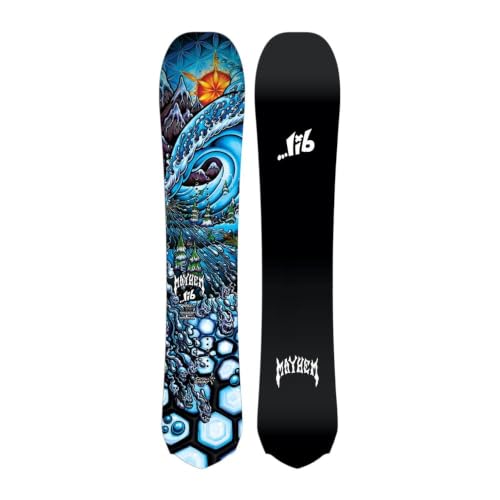
- ✓ Excellent float in powder
- ✓ Precise carving capabilities
- ✓ Lightweight and eco-friendly
- ✕ Slightly pricey
- ✕ Less suited for park riding
| Length | 161.5 cm |
| Shape | Directional with elliptical sidecut |
| Base | Sintered |
| Flex | Light and environmentally friendly construction |
| Design Features | Floatier nose, set-back stance, all-terrain power carver |
| Intended Use | Resort riding and powder snow |
Pulling the Lib Tech Mayhem Rocket out of its box, I immediately noticed its sleek, lightweight build and the vibrant graphics that scream performance. The moment I strapped into it, I felt how the directional shape and the floatier nose set up a confident stance, especially for tackling everything from powder to carved turns.
As I skied through soft snow, the Mayhem Rocket’s new floatier nose really came alive. It effortlessly plowed through deep powder, yet remained stable and responsive on firm terrain.
The elliptical sidecut, synced with a set-back stance, made carving tight turns feel precise and natural, almost like the board read my mind.
What really stood out was how smoothly it transitions from cruising the resort to hitting fresh lines. The sintered base is fast and durable, giving me that extra speed boost when I needed it.
Plus, the lightweight, environmentally friendly construction made it easier to maneuver all day long without feeling bogged down.
It’s clear this board is built for versatility. Whether you’re ripping through the groomers or floating over powder, the Mayhem Rocket delivers.
The overall feel is lively but controlled, making it a true all-terrain beast that handles everything I threw at it with ease.
Of course, the price tag is on the higher side, but the tech and performance justify it. If you want a board that performs from first chair to last run, this one’s a serious contender.
What Innovations Are Transforming Snowboard Technology?
The snowboard industry is experiencing a wave of innovations that enhance performance, safety, and user experience.
- Carbon Fiber Construction: Many high-end snowboards now incorporate carbon fiber in their construction, resulting in lighter boards that provide increased stiffness and responsiveness. This material allows for better energy transfer during turns and jumps, enhancing overall performance on the slopes.
- 3D Base Contours: This technology involves shaping the base of the snowboard to improve glide and maneuverability. By incorporating a three-dimensional design, boards can better adapt to different snow conditions, allowing for quicker edge transitions and enhanced stability.
- Smart Technology: Some brands are integrating smart sensors and Bluetooth technology into their boards to track performance metrics such as speed, jump height, and distance. This data can be analyzed through dedicated apps, providing riders with insights to improve their skills.
- Eco-Friendly Materials: With a growing emphasis on sustainability, many manufacturers are now using eco-friendly materials, such as recycled plastics and sustainably sourced wood. This shift not only reduces environmental impact but also appeals to consumers who prioritize eco-conscious products.
- Advanced Edge Technology: Innovations in edge design, such as serrated edges or varying edge profiles, enhance grip and control on icy surfaces. This technology allows for more precise turns and reduces the risk of catching an edge, making for a safer ride.
- Magnetic Binding Systems: New magnetic binding systems are being developed that allow for quicker and easier attachment and detachment. These systems enhance convenience for riders, especially in changing conditions or when taking breaks.
- Customizable Flex Patterns: Some brands are offering boards with adjustable flex options, enabling riders to customize the stiffness according to their preferences or riding style. This adaptability can significantly enhance comfort and performance, catering to both beginners and advanced riders.
How Do Advanced Materials Improve Snowboard Performance?
Advanced materials significantly enhance snowboard performance by improving factors such as flexibility, weight, durability, and responsiveness.
- Carbon Fiber: Carbon fiber is a lightweight and incredibly strong material that enhances the stiffness and responsiveness of snowboards. This material allows for quicker edge-to-edge transitions and better energy transfer during turns, which can lead to improved performance in varied snow conditions.
- Kevlar: Kevlar is often used in conjunction with other materials to increase a snowboard’s impact resistance and durability. By incorporating Kevlar into the construction, boards can withstand more abuse, reducing the likelihood of damage from rocks or other obstacles on the slopes.
- Wood Core: A wood core offers a natural flex and a lightweight structure that can enhance the overall ride quality. Different types of wood can be used to fine-tune the board’s performance characteristics, such as pop and vibration dampening, making the ride smoother and more enjoyable.
- Epoxy Resins: Advanced epoxy resins are used to bind materials together and provide superior strength and flexibility. These resins can be engineered for specific performance traits, allowing manufacturers to optimize the snowboard’s performance under various conditions.
- Graphene: Graphene is a revolutionary material known for its exceptional strength-to-weight ratio and thermal conductivity. Incorporating graphene in snowboard construction can lead to lighter boards with enhanced durability and improved performance in terms of speed and stability on the snow.
- Sintered Base Materials: Sintered bases are made from high-density materials that are more durable and provide better glide on snow. They absorb wax better than extruded bases, leading to improved speed and a smoother ride over a variety of snow conditions.
What Are the Key Features of the Latest Snowboard Bindings?
The latest snowboard bindings incorporate advanced technology and features to enhance performance, comfort, and control on the slopes.
- Lightweight Materials: Modern snowboard bindings are often constructed from lightweight materials like carbon fiber and advanced plastics. This reduces overall weight, improving agility and responsiveness while maintaining strength and durability.
- Adjustable Highbacks: Many bindings now feature adjustable highbacks that allow riders to customize the angle for better support and control. This enables a more personalized fit that can enhance comfort and performance during different riding styles.
- Tool-Free Adjustments: The latest models often include tool-free adjustments for straps and buckles, allowing riders to make quick changes on the fly. This feature adds convenience, especially in variable conditions or when switching between different boots.
- Enhanced Strap Designs: Newer strap designs often utilize materials that provide better comfort and hold without causing pressure points. Many bindings now feature 3D-contoured straps that conform to the shape of the boot, providing a secure and comfortable fit.
- Shock Absorption Systems: Advanced shock absorption technologies are integrated into bindings to minimize impact and vibrations from rough terrain. This helps reduce fatigue and increases comfort for riders during long sessions on the mountain.
- High-Performance Baseplates: Baseplates are designed with advanced flex patterns and materials to improve energy transfer from the rider to the board. This results in better edge control and responsiveness, particularly during turns and jumps.
- Compatibility with Various Boots: The latest snowboard bindings are designed to be more versatile, offering compatibility with a wider range of boot types and sizes. This ensures that riders can find the perfect binding for their specific setup without worrying about fit issues.
In What Ways is Smart Technology Enhancing the Snowboarding Experience?
Smart snowboards equipped with sensors can analyze a rider’s stance and movements, offering feedback that can help perfect techniques like turning and jumping. This technology allows for a more tailored riding experience, catering to individual skill levels.
Heated gear, such as jackets and gloves, has added convenience for snowboarders who want to remain warm without the bulk. The ability to adjust heating settings via a smartphone ensures comfort throughout the day, regardless of changing weather conditions.
Safety features like avalanche beacons and smart helmets are increasingly important in ensuring the well-being of snowboarders. These technologies help riders maintain communication with each other and receive critical updates about their surroundings.
Augmented reality goggles provide an innovative twist on traditional snowboarding gear by merging technology with the natural experience. By displaying essential information directly in the rider’s line of sight, these goggles enhance situational awareness and help riders navigate more efficiently.
How Can Snowboarders Benefit from Eco-Friendly Innovations?
Snowboarders can significantly benefit from eco-friendly innovations that enhance performance while minimizing environmental impact.
- Recycled Materials: Many snowboard manufacturers are now utilizing recycled plastics and metals to create boards. This innovation reduces waste and lessens the demand for virgin materials, ultimately lowering the carbon footprint associated with snowboard production.
- Sustainable Wood Sources: Eco-friendly snowboards often use wood from sustainably managed forests. This practice ensures that the materials are renewable and supports responsible forestry, which helps combat deforestation and promotes biodiversity.
- Eco-Friendly Resins: Traditional snowboard making often involves harmful chemicals in the resin used for bonding materials. Eco-friendly resins are made from natural sources and are less toxic, contributing to a healthier manufacturing process and reducing harmful emissions during production.
- Biodegradable Components: Some brands are introducing biodegradable parts for bindings and other accessories. This means that at the end of their lifecycle, these components will break down naturally, reducing landfill waste and environmental pollution.
- Low-Impact Manufacturing Processes: Innovations in manufacturing techniques, such as energy-efficient production methods and reduced water use, help minimize the overall environmental impact of snowboard creation. Using renewable energy sources in factories also plays a crucial role in lowering greenhouse gas emissions.
- Carbon Offset Programs: Many companies are now investing in carbon offset initiatives to counterbalance the emissions produced during the manufacturing and transportation of snowboards. By supporting reforestation projects and renewable energy, they contribute to a more sustainable future for the sport.
- Durability and Longevity: Eco-friendly snowboards are often designed for greater durability, which means they last longer and require less frequent replacement. This reduces the overall environmental impact associated with production and waste, making each board a more sustainable choice.
- Innovative Recycling Programs: Some brands offer take-back programs where old snowboards can be returned and recycled. This initiative helps keep boards out of landfills and promotes a circular economy, encouraging responsible consumption among snowboarders.
What Upcoming Trends Should You Expect in Snowboard Technology?
Eco-friendly Materials: Manufacturers are increasingly focusing on sustainable materials, such as bio-resins and recycled plastics, to create environmentally friendly snowboards. This trend not only reduces the environmental impact of snowboard production but also appeals to eco-conscious consumers.
Adaptive Flex Systems: This technology allows for adjustable flex in snowboards, enabling riders to customize their board’s stiffness for different terrains and conditions. Riders can optimize their experience, whether they are carving turns on groomed runs or navigating through backcountry powder.
Enhanced Edge Control: New edge designs and materials are being developed to improve grip and stability, particularly in icy or challenging conditions. These innovations help riders maintain control and confidence, enhancing safety and performance on the slopes.
Lightweight Carbon Fiber Construction: Advances in carbon fiber technology are leading to lighter and stronger snowboard constructions, enhancing performance without sacrificing durability. This lightweight approach allows for easier maneuverability and reduced fatigue during long days on the mountain.
Related Post: