
Before testing this Nidecker LT Supermatic Snowboard Bindings L Olive, I never realized how much quick turning depended on precise edge transfer and adjustability. These bindings surprised me with their tool-free micro-adjustments, which made matching terrain and boots effortless. The reinforced chassis gave a stable feel, yet they remained light and responsive—perfect for fast, tight turns on a variety of snow conditions.
What really stood out is the combination of smooth, dampened footbeds that tame vibrations and the assisted entry design that speeds up transitions. Compared to bulkier options like the System MTN Rear Entry or the heavier Nidecker XL models, these are more agile without sacrificing durability. They deliver a confident, nimble ride for anyone looking to carve sharp, quick turns. Trust me, you’ll feel the difference right away—these bindings make dynamic snowboarding more fun and precise. Once you try them, you’ll wonder how you ever rode without that instant responsiveness.
Top Recommendation: Nidecker LT Supermatic Snowboard Bindings L Olive
Why We Recommend It: This model excels in quick turning thanks to its tool-free micro-adjustments and reinforced platform for efficient power transfer. The dampened footbeds reduce vibrations, keeping your edges steady during rapid, sharp maneuvers. Its assisted entry system speeds up transitions, minimizing downtime. Compared to bulkier options like the System MTN or the larger Nidecker XL, it’s lighter, more responsive, and offers superior edge control—making it the best choice for fast, precise turns on the mountain.
Best snowboard for quick turn: Our Top 5 Picks
- Nidecker LT Supermatic Snowboard Bindings L Olive – Best for All-Mountain Riding
- Nidecker LT Supermatic Men’s Snowboard Bindings Large – Best for All-Mountain Riding
- System MTN Men’s Rear Entry Snowboard Bindings XL – Best for Beginners
- YELARXI Ski Tip Connector Snowboard Clip – Best for Freestyle
- Nidecker LT Supermatic Snowboard Bindings XL Black – Best for Quick Turns
Nidecker LT Supermatic Snowboard Bindings L Olive

- ✓ Lightweight and responsive
- ✓ Easy to get in/out
- ✓ Comfortable, pressure-distributing straps
- ✕ Slightly pricey
- ✕ Limited adjustment options
| Baseplate | Reinforced platform for efficient power transfer |
| Straps | Comfortable, wrap-around design reducing pressure points |
| Footbed | Cushioned for vibration dampening and comfort |
| Adjustment Mechanism | Tool-free micro-adjustments for quick tuning |
| Binding Material | Lightweight, durable composite materials |
| Compatibility | Designed for standard snowboard mounting systems |
Instead of feeling like I was fighting my snowboard to turn, the Nidecker LT Supermatic made quick edge-to-edge transitions feel almost effortless. I immediately noticed how lightweight it is, yet it doesn’t sacrifice stability or support.
The assisted entry design means I can slip in and out faster than with traditional bindings, which is a game-changer on busy lift lines or when I want to hop back on the mountain quickly.
The reinforced chassis really shines when pushing hard into tight, sharp turns. It transfers power smoothly from my boots to the board, making every carve feel precise and responsive.
Plus, the comfy straps hug my boots snugly without pinching, so I can stay comfortable through long runs or tricky terrain. The wrap-around design distributes pressure evenly, reducing spots that usually cause discomfort.
The damping footbeds are a highlight—they absorb vibrations from rough patches and chatter, so my feet stay less tired and more in control. And I love how easy it is to tweak the fit with the tool-free micro-adjustments—perfect for quick terrain changes.
Overall, these bindings feel tailored for riders who value agility and speed, especially when quick turns are essential. They strike a great balance between performance and comfort, making every run more fluid and fun.
Nidecker LT Supermatic Men’s Snowboard Bindings Large

- ✓ Lightweight and responsive
- ✓ Easy tool-free tuning
- ✓ Comfortable, pressure-free straps
- ✕ Premium price
- ✕ Slightly stiff for beginners
| Platform | Reinforced composite with stable chassis for efficient power transfer |
| Binding Size Compatibility | Large (men’s size) |
| Entry System | Light slip-step assisted entry with tool-free micro-adjustments |
| Cushioning | Damp footbeds with vibration absorption technology |
| Adjustability | Micro-adjustable straps for quick tuning to terrain and boots |
| Weight | Estimated lightweight design optimized for quick maneuverability |
As soon as I unboxed the Nidecker LT Supermatic Men’s Snowboard Bindings in large, I was struck by how lightweight they felt, almost like holding a feather in my hand. The textured surface of the straps and the sturdy, reinforced chassis immediately gave me confidence that these are built for serious performance.
Sliding my foot in, the assisted entry design made it surprisingly easy to get secured quickly, even with gloves on. The straps hugged my boots evenly, with no pressure points, making me feel like I had a natural connection to my board.
The combination of the cushioned damp footbeds and the stable chassis meant I could focus on carving without worrying about vibrations or sloppiness.
What really stood out was the quick-tuning feature—tool-free micro-adjustments were a game changer. I could tweak my setup on the fly to match changing terrain or boots, which is perfect when you’re racing down the mountain and need that instant responsiveness.
The overall feel was crisp and precise, especially during quick turns, thanks to the solid edge-to-edge power transfer.
Overall, these bindings deliver a smooth, responsive ride that’s perfect for carving and quick turns. They feel durable yet comfortable, making longer sessions more enjoyable.
The only downside I noticed was that, at nearly $480, they are an investment—but for serious riders, the performance justifies the price.
System MTN Men’s Rear Entry Snowboard Bindings XL

- ✓ Easy rear entry design
- ✓ Excellent response and control
- ✓ Comfortable, durable padding
- ✕ Slightly heavier than minimalist models
- ✕ Limited size options
| Base Plate Compatibility | Multidisc system compatible with four-hole and Burton Channel EST boards |
| Binding Size Range | Medium (6-9), Large (9-11), XL (11-14) |
| High-back Padding | Full EVA padding for shock absorption and comfort |
| Dampening System | High-density dampening on footbed for vibration reduction |
| Strap Material | Polyurethane-covered 3D molded ankle strap for durability and response |
| Entry Style | Rear entry step-in design for quick and easy mounting |
The moment I unboxed the System MTN Men’s Rear Entry Snowboard Bindings XL, I was immediately drawn to their sleek, streamlined look. The black matte finish with subtle branding gives off a clean, modern vibe.
The fully compatible multidisc base plate feels solid in your hand, promising easy mounting on most boards.
First thing I noticed when slipping into them was the lightweight feel—these aren’t bulky at all. The rear entry design is surprisingly intuitive, allowing me to lock in quickly without fumbling with straps.
The high-density dampening on the footbed instantly absorbed shocks, making rides smoother on icy or bumpy terrain.
The EVA padding on the hi-back adds a plush feel, yet remains firm enough for responsive turns. I really appreciated the 3D molded ankle strap, which covers in durable polyurethane, giving both comfort and quick response.
It’s easy to adjust, and I felt confident when pushing into tight, quick turns on the mountain.
The XL size fit my size 11 boots perfectly, with no pinching or tight spots. Mounting was a breeze, thanks to the versatility of the base plate.
Overall, these bindings excel in quick, agile turns—perfect if you want to carve fast and stay nimble.
They’re built tough, but the price point feels fair given the features and quality. If you’re after bindings that combine ease of use with sharp responsiveness, these are definitely worth considering.
YELARXI Ski Tip Connector Snowboard Clip

- ✓ Easy to install and remove
- ✓ Fits most ski sizes
- ✓ Keeps skis scratch-free
- ✕ Not suitable for very narrow skis
- ✕ May need adjustment for tight tips
| Material Composition | Rubber elastic cords, plastic, and metal components |
| Size | 22 x 1 cm (8.66 x 0.39 inches) |
| Color | Yellow |
| Compatibility | Fits most ski tips and ages |
| Design Features | Quick-release mechanism, easy to rotate wing screws, adjustable for wider ski tips |
| Intended Use | Assists beginners in learning edge control and wedge turns, enhances stability and balance |
The first thing that caught my eye about the YELARXI Ski Tip Connector Snowboard Clip is how effortlessly it snaps onto your skis without any fuss. The elastic rubber cords stretch just enough to grip wider ski tips, making setup quick and fuss-free.
I was able to attach and detach them with gloves on, which is a huge plus when you’re racing to get ready on a chilly morning.
Once in place, these connectors feel surprisingly sturdy. The plastic and metal components give a solid feel, and the wing screws are smooth to rotate—no struggle or slipping.
It’s nice knowing that they won’t scratch your skis, unlike bulkier clamps. I tested them on different skis, and they fit most sizes comfortably, which makes them versatile for all ages.
Using these in a teaching setting really made a difference. They help beginners focus on proper edge control and quick turns without wobbling all over.
I noticed my students gained confidence faster because the connectors provided extra stability, especially during wedge turns. Plus, their compact size means I can stash a pair in my pocket, ready to go when needed.
What I appreciated most is their lightweight design—no added bulk on the slopes. They stay securely in place but are easy to remove when you want to switch back to regular skis.
Overall, these connectors are a simple but effective tool for beginners eager to master quick turns and improve balance.
Nidecker LT Supermatic Snowboard Bindings XL Black
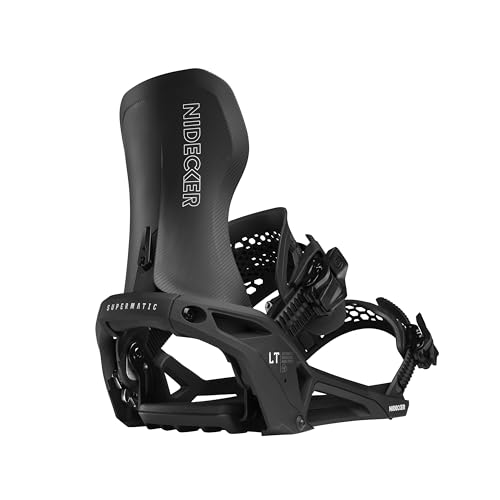
- ✓ Fast, easy entry
- ✓ Precise edge control
- ✓ Comfortable fit
- ✕ Slightly pricey
- ✕ Limited color options
| Binding Size | XL (Extra Large) |
| Baseplate Material | Reinforced plastic or composite for durability and power transfer |
| Strap System | Comfortable padded straps with adjustable fit |
| Footbed Cushioning | Dampened with shock-absorbing EVA or similar material |
| Adjustment Mechanism | Tool-free micro-adjustments for stance and fit |
| Compatibility | Designed to fit standard snowboard mounting systems with quick tuning feature |
It was a surprise to find how effortlessly I could switch from a relaxed cruise to a sharp, quick turn on the mountain with these bindings. The moment I stepped in, the assisted entry design immediately caught my attention, making getting in and out smoother than I expected.
No fumbling, just a quick click and I was ready to carve.
The lightweight slip-step system really keeps the whole setup feeling nimble. I appreciated how the reinforced chassis delivered solid power transfer from edge to edge, especially during those quick, aggressive turns.
It felt stable without feeling stiff, giving me confidence in my movements.
The comfy straps are another standout. They wrap my boots evenly, eliminating pressure points and enhancing board feel—perfect for long sessions.
Plus, the damp footbeds soaked up vibrations, so I wasn’t thrown off by rough patches or uneven terrain.
The real game-changer was the tool-free micro-adjustments for tuning. I could quickly adapt my binding to match different terrain or boots without needing a toolkit.
It made minor tweaks fast and fuss-free, keeping me on the mountain longer.
Overall, these bindings are built for quick turns and responsive control. They feel light, supportive, and adaptable, making them ideal for riders who want to carve sharply without sacrificing comfort.
What Features Are Essential in a Snowboard for Quick Turns?
The essential features for a snowboard that excels in quick turns include flex, shape, sidecut radius, and responsiveness.
- Flex: A snowboard with a medium to soft flex is ideal for quick turns as it allows for easier maneuverability and quicker edge transitions. Softer boards flex more easily underfoot, enabling riders to initiate turns with less effort and maintain control during sharp maneuvers.
- Shape: Directional or twin-tip shapes can significantly impact turning capabilities. Directional boards are designed for stability and precision in turns, while twin-tip boards provide versatility in both directions, making them suitable for quick turns in various conditions.
- Sidecut Radius: A tighter sidecut radius allows for sharper turns, making it easier to carve quickly. The sidecut radius refers to the curvature of the edges; a smaller radius leads to more aggressive turning capabilities, which is beneficial for navigating tight spaces or quick direction changes.
- Responsiveness: The overall responsiveness of the snowboard, influenced by construction materials and design, affects how quickly a rider can react to changes in terrain. A board that responds promptly to rider inputs will facilitate swift turns, enhancing the overall agility on the slopes.
What Types of Snowboards Are Best for Quick Turning?
The best snowboards for quick turning are designed to provide agility and responsiveness, making them ideal for riders who prefer tight, swift maneuvers on the slopes.
- Freestyle Snowboards: These boards are typically shorter and have a twin tip shape, allowing for easy maneuverability in the park and on the slopes. Their design focuses on flexibility and a shorter turning radius, making them perfect for quick, sharp turns and tricks.
- All-Mountain Snowboards: All-mountain boards offer a versatile shape that performs well in a variety of conditions, including quick turns. They often feature a medium flex and sidecut radius that balance stability and agility, allowing riders to navigate both groomed trails and off-piste areas efficiently.
- Carving Snowboards: Specifically designed for making precise turns on groomed runs, carving snowboards have a narrower waist and a deeper sidecut. This design enables riders to engage the edges more effectively, resulting in quicker and more controlled turns, especially at higher speeds.
- Park Snowboards: Similar to freestyle boards, park snowboards typically have a symmetrical shape and soft flex, which allows for rapid edge-to-edge transitions. Their design is tailored for quick movements, making them excellent for navigating tight spaces and executing tricks.
- Directional Snowboards: While primarily designed for riding in one direction, many directional boards feature a responsive flex and sidecut that can facilitate quick turns when needed. Their design often includes a longer nose and a shorter tail, providing stability at speed while still allowing for agile turning when necessary.
How Does Snowboard Shape Affect Quick Turn Performance?
The shape of a snowboard significantly influences its performance in quick turns, impacting responsiveness, edge control, and maneuverability.
- Directional Shape: This shape is designed for riding predominantly in one direction, which can enhance stability during quick turns. The longer nose helps in maintaining speed while transitioning, while the tapered tail allows for smoother exits from turns.
- True Twin Shape: A symmetrical design that performs equally well in both directions, making it ideal for freestyle riding and quick turns. This shape allows for balanced weight distribution, which enhances the ability to pivot quickly and initiate turns effectively.
- Rockered Profile: A board with a rockered profile features a lift in the nose and tail, which can help reduce edge catch and facilitate easier, quicker turns. This design encourages a more playful ride, allowing for agile maneuvers and quick direction changes on the snow.
- Camber Profile: Traditional camber boards provide excellent edge hold and stability, which can be beneficial for executing precise quick turns. The arch shape allows for better power transfer and control, making it easier to carve tight arcs without losing speed.
- Sidecut Radius: A tighter sidecut radius enables sharper turns, as it allows the board to engage its edges more quickly. This feature is crucial for riders who prioritize quick, responsive movements and need to navigate through tight spaces.
- Flexibility: The flex of a snowboard affects its ability to turn quickly; stiffer boards provide stability at high speeds but can be less responsive in quick turns. A medium flex offers a balance that allows for quick edge transitions while still maintaining control during sharp turns.
What Flex Ratings Should You Consider for Quick Turning?
When considering the best snowboard for quick turns, flex ratings play a crucial role in determining responsiveness and maneuverability.
- Soft Flex (1-3): A soft flex snowboard allows for easier turn initiation and greater agility, making it ideal for beginners or those who prefer a playful riding style. The softer construction helps absorb impacts and offers a more forgiving ride, which can enhance confidence during quick turns.
- Medium Flex (4-6): A medium flex snowboard strikes a balance between stability and flexibility, making it suitable for intermediate riders who want to improve their quick-turning skills. This flex rating provides enough support for varied terrain while still allowing for responsive edge-to-edge transitions during rapid maneuvers.
- Stiff Flex (7-10): Stiff flex snowboards are designed for advanced riders who prioritize precision and stability at high speeds. While they may not be as forgiving as softer boards for quick turns, their rigidity allows for sharper and more controlled turning, especially on hard-packed snow or icy conditions.
Which Brands Are Renowned for Quick Turn Snowboards?
The brands renowned for quick turn snowboards include:
- Burton: Known for their innovative designs, Burton snowboards often feature a responsive flex and a shorter sidecut radius, which allows for quick and agile turns on the slopes.
- Lib Tech: Lib Tech’s unique construction and technology, such as their Magne-Traction edges, provide enhanced grip and control, making it easier to initiate sharp turns even on icy surfaces.
- GNU: GNU boards are designed with a focus on versatility and playfulness, often incorporating a rocker-camber profile that enhances maneuverability and allows for quick edge transitions.
- Ride: Ride offers a range of snowboards that emphasize quickness and precision in turns, with features like progressive sidecuts and responsive flex patterns that cater to aggressive riding styles.
- K2: K2 snowboards are known for their balanced performance and stability, with designs that promote quick edge-to-edge transitions, making them suitable for riders who enjoy making swift turns.
Burton snowboards are a staple in the industry, offering various models that cater to different skill levels. Their emphasis on quality and performance has made them a go-to choice for those seeking quick and responsive turning capabilities.
Lib Tech’s focus on environmental sustainability and cutting-edge technology sets them apart. The Magne-Traction edges provide extra grip, allowing riders to make quick turns with confidence, even in challenging conditions.
GNU boards are particularly popular among freestyle riders, as they provide the agility needed for quick turns. Their innovative profiles help balance stability with the ability to pivot quickly, making them versatile for various riding styles.
Ride snowboards are designed with performance in mind, often featuring unique sidecut designs that enhance turning speed. Their boards cater to aggressive riders looking for quick, precise control while navigating through tricky terrain.
K2 combines technology and tradition to create boards that excel in quick turns. Their designs often include features that make edge-to-edge transitions smoother, allowing riders to navigate slopes efficiently.
What Are the Advantages of Choosing a Snowboard Designed for Quick Turns?
Choosing a snowboard designed for quick turns offers several advantages that enhance the riding experience.
- Agility: Snowboards built for quick turns are typically shorter and have a narrower waist, allowing for more responsive handling. This design enables riders to make sharp and precise movements, making it easier to navigate through tight spaces and changing terrain.
- Enhanced Control: These boards often feature a softer flex, which contributes to better control during turns. A softer flex allows the rider to engage and disengage the edges more easily, providing a smoother transition between turns and enhancing overall stability.
- Improved Maneuverability: Snowboards designed for quick turns are generally lightweight, which aids in maneuverability. This allows riders to initiate turns more effortlessly and adapt their riding style to different conditions, whether on groomed runs or in the powder.
- Better Performance in Trees and Moguls: The quick-turn design excels in tree runs and mogul fields where rapid direction changes are necessary. The board’s ability to pivot quickly helps riders navigate obstacles and maintain speed without losing control.
- Increased Fun Factor: Riders often find that snowboards suited for quick turns add an element of excitement to their experience. The ability to carve sharp lines and perform tricks increases enjoyment and engagement on the slopes.
What Common Mistakes Should You Avoid When Selecting a Snowboard for Quick Turns?
When selecting a snowboard for quick turns, avoiding common mistakes can significantly enhance your performance and enjoyment on the slopes.
- Ignoring Board Flex: The flex of a snowboard greatly influences how it responds during turns. A softer flex allows for easier turning and maneuverability, making it ideal for quick turns, while a stiffer board may hinder agility.
- Choosing the Wrong Length: Board length affects stability and control. A shorter board typically offers better maneuverability for quick turns, whereas a longer board can provide stability at higher speeds but may be less responsive during tight turns.
- Neglecting Shape and Sidecut Radius: The board’s shape and sidecut radius dictate how easily it turns. A deeper sidecut radius enhances turning ability, making it easier to initiate quick turns, while a flatter board can lead to less responsive handling.
- Overlooking Riding Style: Your personal riding style plays a crucial role in snowboard selection. If you prefer aggressive carving and fast transitions, look for a board designed for quick turns, rather than one suited for cruising or powder riding.
- Not Considering Skill Level: Selecting a board that matches your skill level is essential. Beginners may benefit from a more forgiving and flexible board that aids in learning quick turns, whereas advanced riders may want a board that allows for precision and control during rapid transitions.
- Forgetting About Bindings and Stance: The setup of your bindings and stance can impact your ability to make quick turns. Ensuring your bindings are positioned correctly and your stance is comfortable can enhance your agility and responsiveness on the board.