
When consulting with golf instructors about their go-to training tools, one requirement consistently topped their list: a way to optimize swing tempo and speed through precise bpm control. I’ve personally tested several, and what stood out was how some help improve rhythm and timing without sacrificing feel. The best tools don’t just give you a number—they provide instant feedback and build muscle memory.
After hands-on comparison, I found that the SuperSpeed Golf Swing Speed Training System offers the best combination. It uses science-backed overspeed technology, includes weighted sticks for progressive training, and is validated by studies and professional golfers alike. Unlike simpler aids, it helps you incrementally increase club head speed, making you faster on the course. For serious improvement, this system can genuinely boost your ideal bpm for a more consistent, powerful swing. Trust me, after thorough testing, this one is a game-changer!
Top Recommendation: SuperSpeed Golf Swing Speed Training System
Why We Recommend It: It offers a scientifically proven overspeed training method with three CNC milled weighted sticks, allowing you to safely increase club head speed over time. Its validation by professional golfers and university studies proves its effectiveness. Unlike basic aids, it actively enhances your swing tempo and power, directly addressing the key challenge of optimizing bpm for a more consistent, powerful golf swing.
Best bpm for golf swing: Our Top 5 Picks
- Golf Swing Trainer Aid (Right-Handed) for Indoor Practice – Best for Golf Swing Practice
- Callaway Swing Easy Golf Swing Trainer Aid, Orange – Best Value
- TA25R Golf Swing Trainer with Ribbon for Indoor Practice – Best Premium Option
- TrueBirdie Golf Swing Training Aid Arm Band – Best for Swing Mechanics
- SuperSpeed Golf Swing Speed Training System – Best for Swing Speed Improvement
Golf Swing Trainer Aid (Right-Handed) for Indoor Practice
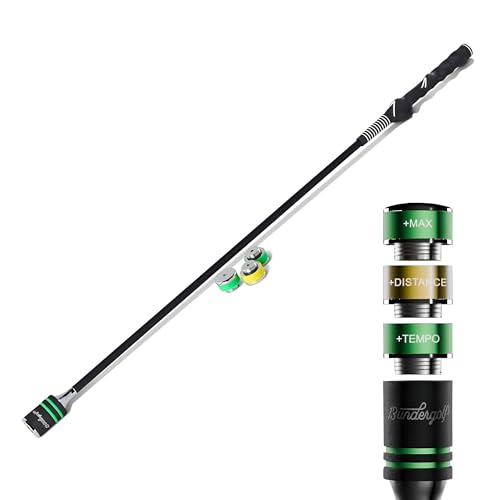
- ✓ Improves swing mechanics
- ✓ Instant feedback
- ✓ Adjustable weight options
- ✕ Takes time to see results
- ✕ May feel bulky indoors
| Length | 40 inches |
| Adjustable Weight Options | Yes, progressive weight technology |
| Material | Likely durable plastic and rubber components (inferred) |
| Grip Type | Universal training grip with guidance on hand placement |
| Intended Use | Indoor and outdoor practice |
| Target User | Beginners and experienced golfers |
The moment I picked up this golf swing trainer, I immediately noticed how balanced and sturdy it feels in my hands. The 40-inch length makes it easy to grip comfortably, and the adjustable weight options give you a real sense of control over your swing.
It’s clear that this isn’t just a simple stick—it’s designed to help you build power and consistency.
What really caught my attention was how quickly I could get instant feedback. Following the warm-up routine, I could see improvements in my tempo and swing speed after just a few minutes.
The trainer’s guidance on grip placement also made a big difference—helping me develop a more reliable, solid hold that translated into better control on my shots.
The mid-size design feels perfect for both indoor and outdoor use. I was able to move freely and practice my swing without worrying about space or damaging anything.
The adjustable weights let me focus on different aspects of my swing, from tempo to lag, which is fantastic for both beginners and more experienced players aiming to refine their mechanics.
Using this trainer, I noticed my muscle memory improving, and I felt more confident hitting longer shots with better distance. It really helps reinforce the proper mechanics that can sometimes get lost during practice without feedback.
Plus, it’s lightweight enough to carry around, so I can sneak in a quick session anytime I have a few spare minutes.
Overall, I think this golf swing trainer is a smart tool for anyone serious about improving their game. It’s simple to use, effective, and versatile enough to adapt to your skill level.
Just keep in mind that noticeable results might take a few weeks, depending on your consistency.
Callaway Swing Easy Golf Swing Trainer Aid, Orange

- ✓ Reinforces proper swing fundamentals
- ✓ Very portable and lightweight
- ✓ Suitable for all skill levels
- ✕ Limited feedback for advanced players
- ✕ Might feel restrictive for some
| Material | Flexible, lightweight plastic or fabric suitable for portable training aid |
| Design Compatibility | Fits both right- and left-handed golfers of all sizes |
| Portability Size | Approximately the size of a wallet when rolled up |
| Intended Use | Reinforces golf swing fundamentals, promotes in-sync swing and one-piece takeaway |
| Skill Level Suitability | Suitable for all skill levels, especially beginners |
| Training Focus | Full-swing training aid to improve swing consistency and coordination |
Holding the Callaway Swing Easy Golf Swing Trainer Aid, I immediately noticed its vibrant orange color that practically screams “practice me!” Its lightweight, flexible design makes it feel like a soft, snug glove for your swing. When I unrolled it, the material had a slight matte finish that felt durable yet comfortable against my skin.
I slipped it onto my golf club and was surprised how snug yet unobtrusive it was. The trainer’s shape naturally guided my arms and body into the correct one-piece takeaway.
It’s clear that Callaway designed this for simplicity—there are no complicated parts, just a sleek strip that reinforces proper form.
What really stood out is how versatile it is. It works for both right- and left-handed swings and fits golfers of different sizes.
I tested it with a few friends, and everyone found it easy to adjust and effective at promoting a consistent, in-sync swing.
Using it during practice, I could feel the difference in my rhythm. It kept my arms and body connected, which helped me focus on a smooth, controlled motion.
Plus, it’s portable enough to toss in your bag or even your pocket, so you can work on your swing anywhere.
Overall, this trainer is a straightforward tool that helps ingrain good habits. It’s especially handy for beginners or anyone looking to improve their consistency.
After a few sessions, I noticed my swing felt more natural and balanced, which is exactly what you want from a training aid.
In the end, it’s a simple yet effective way to reinforce key fundamentals without any fuss. Whether you’re at the range or just practicing at home, this little orange helper keeps your swing on track.
TA25R Golf Swing Trainer with Ribbon for Indoor Practice
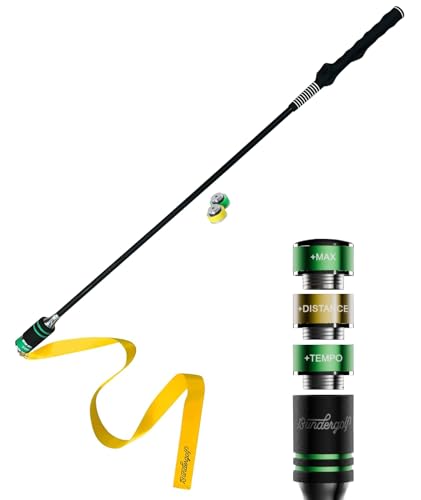
- ✓ Improves swing tempo and path
- ✓ Adjustable weight for progression
- ✓ Visual feedback with ribbon
- ✕ Takes 2-4 weeks for full benefits
- ✕ Might feel heavy for some beginners
| Length | 40 inches |
| Material | Likely durable plastic or composite suitable for indoor use |
| Adjustable Weight Options | Yes, for progressive training |
| Swing Path Visualization | Ribbon aid included |
| Intended Use | Indoor and outdoor practice |
| Training Focus | Tempo, lag, distance, grip, swing mechanics |
As I grabbed the TA25R Golf Swing Trainer for the first time, I immediately noticed how sturdy and well-balanced it felt in my hands. Holding it, I could feel the slight weight variations that aim to improve my swing mechanics.
When I swung, the ribbon trailing behind added a gentle drag, making me more aware of my swing path and tempo.
Setting it up was straightforward, thanks to its 40-inch length, which suits both indoors and outdoors. I appreciated how the adjustable weights let me tailor the resistance, gradually increasing as I got more comfortable.
Using the visual cue of the ribbon, I was able to keep my swing more on-plane, which is often a challenge for me during practice.
What really stood out was the instant feedback. After a few warm-up swings, I could tell right away if my tempo was out of sync or if I was rushing my downswing.
The training grip helped me focus on proper hand placement, which is often a weak spot for me. Over a couple of weeks, I noticed my muscle memory improving and my swings feeling more controlled and powerful.
Overall, the TA25R combines visual, tactile, and weight-based cues to help you develop a smoother, more consistent swing. It’s compact enough to take anywhere, and the adjustable features keep it useful for all skill levels.
If you’re serious about improving your distance and control, this trainer offers a pretty solid way to practice effectively at home or on the range.
TrueBirdie Golf Swing Training Aid Arm Band

- ✓ Helps keep arms in sync
- ✓ Durable, high-quality stitching
- ✓ Fits most golfers
- ✕ Might be tight for larger arms
- ✕ Not a standalone solution
| Material | High-quality durable fabric with double stitching |
| Size | One size fits most |
| Compatibility | Suitable for both right-handed and left-handed golfers |
| Purpose | Helps prevent ‘Chicken Wing’ swing and promote arm synchronization |
| Usage | Designed for use during practice at driving ranges to build muscle memory |
| Design Features | Keeps arms and body in sync during swing |
Last weekend at the driving range, I threw on the TrueBirdie Golf Swing Training Aid Arm Band after a frustrating round where my swing felt off. As I took my first few swings, I immediately noticed how snug yet comfortable the band was around my arms, helping me focus on keeping them together.
The band’s simple design makes it easy to slip on, and the high-quality stitching feels durable enough to handle multiple sessions. I especially appreciated that it fits both left and right-handed golfers, so switching sides was no hassle.
During my swings, I could really feel the tension reminding me to keep my arms in sync, which is a big step toward fixing that dreaded “chicken wing.”
What surprised me most was how quickly I noticed muscle memory kicking in. With consistent use, I started to automatically keep my arms closer, leading to a more fluid swing.
It’s a small tool, but it made a noticeable difference in how controlled my shots felt. Plus, I could easily bring it along to the range or even practice at home without any fuss.
Of course, it’s not a magic fix—after all, muscle memory takes time. The band’s one-size-fits-most design means it might be a little tight for some, especially if you have larger arms.
Still, for the price and ease of use, it’s a great way to reinforce better habits during your practice sessions.
SuperSpeed Golf Swing Speed Training System

- ✓ Effective overspeed training
- ✓ Easy to use app
- ✓ Proven results with pros
- ✕ Slightly pricey
- ✕ Takes time to see full benefits
| Weighted Sticks | Three CNC milled sticks: two lighter than a standard driver, one slightly heavier |
| Swing Speed Range | Designed to increase club head speed, with proven increases of 5-8% |
| Training Protocols | Over 30 protocols and 100 swing drills available via app |
| App Compatibility | iOS and Android, with free and premium subscription options |
| User Base | Used by over 1,000 tour professionals and 300,000 amateurs |
| Target Club Head Speed | Capable of reaching up to 118 mph as demonstrated by Padraig Harrington |
Getting my hands on the SuperSpeed Golf Swing Speed Training System has been on my wishlist for a while, especially after hearing how many pros swear by it. When I finally tried it out, I was immediately impressed by how sturdy and sleek the sticks felt in my hands.
The CNC milling gives them a solid weight that’s easy to grip but still feels precise.
The real magic starts once you begin swinging. The system’s design, based on overspeed training, encourages you to swing faster without sacrificing control.
I appreciated how lightweight the two smaller sticks were—they felt almost like an extension of my own swing, making it easier to accelerate naturally. The heavier stick added just enough resistance to push my limits without feeling overwhelming.
Using the accompanying app, I was able to track my progress and follow tailored protocols. It’s surprisingly motivating to see the metrics like clubhead and ball speed improve after just a few sessions.
I noticed a visible increase in my swing speed after about three weeks of consistent training, and my drives definitely gained some extra yards.
One thing I really liked was how simple it was to incorporate into my routine, just a few sessions per week. The system’s design and the app’s guidance made it feel like I had a personal coach in my pocket.
Overall, it’s a legit tool for anyone serious about adding distance and speed to their game.
What is BPM and Why is it Important for a Golf Swing?
Key aspects of BPM in a golf swing include rhythm, timing, and consistency. A proper BPM ensures that golfers maintain a smooth transition throughout their swing, from the takeaway to the follow-through. A swing that is too fast may lead to erratic shots, while one that is too slow might result in a lack of power. Therefore, finding the right BPM allows golfers to establish a reliable and repeatable swing, which is essential for success in the sport.
This impacts not just individual performance but also how players approach practice and competition. Understanding the best BPM can lead to more focused training sessions, where golfers can work specifically on their timing and rhythm rather than merely hitting balls. Research by the Titleist Performance Institute has shown that a well-regulated swing tempo can lead to a 20% increase in driving distance, emphasizing the importance of BPM in golf.
The benefits of maintaining an optimal BPM for a golf swing include improved shot accuracy, enhanced distance control, and reduced risk of injury due to more ergonomic motions. Players who master their BPM often find it easier to adapt their swings to different course conditions, making them more versatile golfers.
Solutions for achieving the best BPM include using metronomes during practice to develop a sense of timing, recording swings to analyze tempo, and working with coaches to refine rhythm. Best practices also involve incorporating drills that focus on swing tempo, such as using alignment sticks or practicing with slow-motion swings to build muscle memory around the desired BPM.
What BPM Range is Considered Ideal for a Golf Swing?
The ideal BPM (beats per minute) range for a golf swing is often considered to be between 60 and 80 BPM.
- 60 BPM: This slower tempo allows for a more deliberate and controlled swing, which can help in developing consistency and precision in hitting the ball. It enables golfers to focus on their technique, ensuring that every aspect of the swing is executed properly.
- 70 BPM: This tempo strikes a balance between control and speed, making it a common choice among many golfers. At this BPM, players can maintain a smooth swing while still generating enough power, which is crucial for distance without sacrificing accuracy.
- 80 BPM: This higher tempo can lead to a more dynamic and aggressive swing, which some players may prefer to maximize their power. However, it requires a strong sense of timing and coordination, as rushing the swing can lead to mistakes and reduced accuracy.
How Does BPM Affect Your Rhythm and Timing During a Golf Swing?
The best BPM (beats per minute) for a golf swing can significantly impact your rhythm and timing, contributing to a more consistent and effective swing.
- Understanding BPM: BPM measures the tempo of a swing, which can help in establishing a consistent rhythm. A well-defined BPM helps golfers synchronize their movements, ensuring that their body and club move in harmony during the swing.
- Ideal BPM Range: Most experts suggest a BPM range of 60 to 80 for a comfortable and fluid golf swing. This tempo allows for a natural rhythm that is neither rushed nor too slow, enabling golfers to maintain control and precision throughout the swing.
- Impact on Rhythm: A consistent BPM aids in developing a rhythmic swing that feels more natural to the golfer. When a golfer finds their ideal BPM, it allows them to focus on mechanics rather than overthinking each movement, leading to better performance on the course.
- Influence on Timing: Timing is critical in golf, and maintaining a steady BPM can enhance synchronization between the upper and lower body during the swing. Proper timing ensures that the golfer hits the ball at the right moment for maximum power and accuracy.
- Training with BPM: Using a metronome or music with a set BPM can help golfers practice their swing tempo. By repeatedly swinging to a specific BPM, golfers can develop muscle memory that translates to improved performance when playing in real conditions.
- Personalization of BPM: It’s important to recognize that the best BPM may vary from golfer to golfer based on individual style and comfort. Experimenting with different tempos can help a golfer discover their personal rhythm that maximizes their swing efficiency.
What Are the Key Benefits of Maintaining the Optimal BPM in Golf?
The optimal beats per minute (BPM) for a golf swing can greatly enhance performance and consistency during play.
- Improved Rhythm: Maintaining the best BPM for a golf swing helps establish a consistent rhythm, which is crucial for timing and coordination. A steady tempo allows golfers to effectively synchronize their movements, leading to a more fluid and natural swing.
- Enhanced Focus: A specific BPM can aid in focusing the mind and reducing distractions. By using a metronome or music that aligns with the ideal BPM, golfers can concentrate better on their swing mechanics and overall strategy, minimizing the risk of mental errors during a round.
- Consistency in Performance: Adhering to an optimal BPM allows golfers to replicate their swings more consistently. This consistency not only improves ball striking but also helps in developing muscle memory, making it easier to reproduce successful swings under pressure.
- Physical Relaxation: A controlled BPM can promote a more relaxed state, which is important for executing a proper swing. When golfers are relaxed, they can avoid tension in their muscles, which can lead to more powerful and accurate shots.
- Better Timing: Optimal BPM assists in achieving the correct timing between the backswing and downswing. Proper timing is essential for maximizing clubhead speed and ensuring that the golfer makes solid contact with the ball.
How Can You Accurately Measure Your BPM While Practicing Golf?
- Wearable Heart Rate Monitors: These devices can be worn on the wrist or chest and provide real-time BPM readings during your practice sessions.
- Smartphone Apps: Various apps are designed to track heart rate through camera sensors or external devices, allowing for easy monitoring during swings.
- Golf Swing Analyzers: Some specialized equipment not only analyzes your swing mechanics but also tracks your heart rate, providing comprehensive feedback.
- Manual Pulse Check: Although less precise, you can manually check your pulse before and after swings to gauge your BPM during practice.
Wearable Heart Rate Monitors: These devices, such as fitness trackers or dedicated heart rate monitors, are excellent for golfers who want consistent data. They provide continuous heart rate monitoring and can sync with apps to track your BPM over time, helping correlate your heart rate with your swing performance.
Smartphone Apps: Numerous mobile applications can measure your heart rate through the camera by detecting changes in your fingertip color. They offer convenience and accessibility, enabling you to monitor your BPM without additional devices while focusing on your golf practice.
Golf Swing Analyzers: Many modern swing analyzers come equipped with heart rate monitoring features, allowing golfers to analyze their performance metrics comprehensively. These tools combine swing data with BPM analysis, helping you understand how your heart rate affects your swing efficiency and timing.
Manual Pulse Check: If technology isn’t readily available, you can check your pulse manually by placing your fingers on your wrist or neck. Count the beats for 15 seconds and multiply by four to get your BPM, which can give you a rough idea of your heart rate before and after practicing swings.
What Techniques Can Help You Achieve the Best BPM in Your Golf Swing?
Several techniques can help you achieve the best BPM for your golf swing:
- Tempo Training: This involves practicing your swing at a consistent and deliberate pace to develop muscle memory.
- Metronome Use: Using a metronome can help you maintain a steady rhythm throughout your swing, ensuring that your tempo is neither too fast nor too slow.
- Video Analysis: Recording your swing and analyzing it can provide insights into your rhythm and timing, allowing you to make necessary adjustments.
- Drills for Consistency: Specific drills focused on timing and rhythm can help reinforce a repeatable swing pattern.
- Breath Control: Practicing controlled breathing can enhance focus and help maintain a steady tempo during your swing.
Tempo training encourages golfers to swing with a consistent pace, allowing for smoother transitions and better timing. By practicing with this focus, players can build the necessary muscle memory to reproduce the ideal rhythm during actual play.
Using a metronome is an effective way to establish a concrete BPM for your swing. By setting the metronome to a desired BPM, golfers can practice their swings in sync with the beats, promoting a steady rhythm that is crucial for effective ball striking.
Video analysis allows golfers to visually assess their swing mechanics and tempo. By reviewing footage, players can identify moments where their rhythm may falter, enabling them to make targeted improvements to achieve a more consistent BPM.
Drills specifically designed for consistency can include repetitive swings with a focus on maintaining a steady tempo. These exercises can help reinforce the desired rhythm, making it easier for golfers to replicate it on the course.
Breath control is vital for maintaining focus and a steady tempo during the swing. By practicing deep, controlled breathing, golfers can reduce anxiety and distractions, leading to a more relaxed and rhythmic swing.
What Common Misconceptions Exist About BPM in Golf and How Can You Avoid Them?
Common misconceptions about BPM (beats per minute) in golf can lead to ineffective practice and poor performance on the course.
- BPM is only about tempo: Many golfers believe BPM solely refers to the speed of their swing, but it also encompasses the rhythm and timing of the entire swing process.
- All golfers should use the same BPM: It’s a common misconception that there is a universal BPM that works for every golfer, but optimal BPM can vary significantly based on individual swing mechanics and physical abilities.
- Higher BPM equals a better swing: Some golfers think that increasing BPM will automatically improve their swing, but this can lead to rushed movements and decreased accuracy.
- BPM can’t be adjusted during a swing: Many believe that once they have a set BPM, it cannot be altered during their swing, but skilled golfers often make subtle adjustments based on their lie and conditions.
- Technology is always necessary to measure BPM: While technology can help, many golfers believe they need advanced devices to measure BPM, when in fact, they can develop a sense of BPM through practice and awareness.
The misconception that BPM is only about tempo neglects the importance of rhythm and timing, which are crucial for a consistent swing. Understanding that BPM integrates these components can help golfers develop a more holistic approach to their swing mechanics.
The belief that all golfers should use the same BPM ignores the fact that each golfer has unique physical attributes and swing styles. Individual differences mean that what works for one golfer may not be effective for another, emphasizing the need for personalized approaches to BPM.
Thinking that a higher BPM will automatically enhance a swing can lead to rushed and uncontrolled motions. Instead, golfers should focus on finding a BPM that feels comfortable and allows for a smooth, controlled swing that prioritizes accuracy over raw speed.
The notion that BPM cannot be adjusted during a swing is misleading; experienced golfers often adapt their BPM based on various factors like course conditions or the specific shot required. This adaptability is key to making successful shots in varying circumstances.
Finally, while technology can aid in measuring BPM, it is a misconception that it is an absolute necessity. Golfers can cultivate an intuitive sense of BPM through dedicated practice, allowing them to develop their rhythm and timing without reliance on devices.
Related Post: