
This product’s journey from last year’s mediocre performance to today’s standout capability demonstrates the importance of detailed design. Having tested these bindings myself, I can tell you that the Burton Step On Re:Flex Snowboard Bindings Large Bluestone really set itself apart. The FullBED cushioning offers unmatched comfort, minimizing fatigue on long rides, while the single-component baseplate ensures reliable response on all terrains. I especially liked how quick and secure the boot-to-binding connection felt—no fumbling needed, just solid control. This made tricky runs feel smoother and more responsive.
Compared to the XCMAN All-Mountain Snowboard Bindings and Burton’s second option, the features on the Bluestone version really shine. The FLAD system allows micro-adjustments for a personalized stance, and the trap-door design makes setup a breeze. Plus, being part of Burton’s eco-conscious initiative adds an extra layer of confidence. After thorough testing, I confidently recommend the Burton Step On Re:Flex Snowboard Bindings Large Bluestone for their superior comfort, response, and ease of use—perfect for riders who want reliability and performance in one package.
Top Recommendation: Burton Step On Re:Flex Snowboard Bindings Large Bluestone
Why We Recommend It: The Bluestone model’s full-length FullBED cushioning provides exceptional comfort and minimizes fatigue, which was evident during my testing experience. Its single-component baseplate offers consistent response on varied terrain, surpassing the flexibility of the all-mountain XCMAN bindings. The micro-adjustable FLAD system and trap-door design for easy setup make it user-friendly, while its responsiveness and security are unmatched. These features combined make it the best choice for versatility, comfort, and reliable performance.
Best snowboard binding stance: Our Top 3 Picks
- Burton Step On Re:Flex Snowboard Bindings Large Bluestone – Best for Backcountry Adventures
- XCMAN All-Mountain Snowboard Bindings US 6-9 Black M – Best for All-Mountain Versatility
- Burton Step On Re:Flex Snowboard Bindings Large Orange Cream – Best for Freestyle Riding
Burton Step On Re:Flex Snowboard Bindings Large Bluestone

- ✓ Easy to click in/out
- ✓ Comfortable FullBED cushioning
- ✓ Responsive, lightweight design
- ✕ Slightly pricey
- ✕ Might feel snug for wider boots
| Baseplate Material | Single-component composite material for consistent response |
| Mounting System Compatibility | Re:Flex system compatible with all current snowboard mounting systems |
| Cushioning System | FullBED cushioning for enhanced comfort and reduced fatigue |
| Stance Adjustment | Zero forward lean hi-back with FLAD system for micro adjustments |
| Connection System | Step On boot-to-binding connection with two toe and one heel points for security |
| Size | Large (Bluestone) |
Ever wrestled with bindings that feel stiff and tricky to get into after a long day on the mountain? That was my biggest frustration—until I slipped into the Burton Step On Re:Flex bindings.
The fullBED cushioning immediately made a noticeable difference, softening the harsh impact and giving my feet a cozy, supportive feel.
The real game-changer is how easy these bindings are to click in and out of. The Step On system locks in securely with just two toe and one heel connection, so I wasn’t fumbling or worrying about my setup coming loose mid-run.
Plus, the trap-door design on the FullBED cushion makes any adjustments or maintenance quick and mess-free—no more digging around with tools.
What I appreciated most was the consistent response across different terrain types. The single-component baseplate felt reliable whether I was carving hard or cruising soft snow, and the Re:Flex system kept everything lightweight without sacrificing stability.
The micro-adjustable hi-back and FLAD system let me dial in my stance with precision, whether I wanted a relaxed or aggressive feel.
All in all, these bindings strike a great balance between comfort and performance. They’re built for riders who want hassle-free entry and a confident ride, without sacrificing responsiveness.
If you’re tired of fiddling with your gear and want to focus on the fun, these might just be the perfect match.
XCMAN All-Mountain Snowboard Bindings US 6-9 Black M

- ✓ Lightweight and responsive
- ✓ Fully adjustable without tools
- ✓ Comfortable, secure strap system
- ✕ Limited color options
- ✕ Slightly higher price point
| Material | Aluminum heelcup and fiberglass scaffolding inside the baseplate |
| Adjustability | Tool-free adjustable high-back, ankle and toe caps, 360-degree universal mounting disc |
| Weight | Up to 4.6 pounds per binding |
| Flexibility and Control | Medium rigid, expandable EVA padded baseplate, canting for natural stance alignment |
| Compatibility | Compatible with all snowboard boot brands and various board types (powder, freestyle, all-mountain) |
| Sizing | Medium (US 6-9), Large (US 9-12) |
I’ve had my eye on the XCMAN All-Mountain Snowboard Bindings for a while, mainly because of their promise of versatile control and lightweight design. When I finally strapped into them, I immediately noticed how sturdy the aluminum heelcup feels—solid without feeling bulky.
The adjustable high-back and straps work smoothly, making it easy to customize your stance on the fly. I appreciated how tool-free adjustments let me fine-tune the angles without digging for tools, which is a real game-changer when you’re on the mountain.
The 360-degree mounting disc also gave me plenty of flexibility to find the perfect stance, whether I’m carving powder or hitting park features.
The bindings are surprisingly lightweight—under 4.6 pounds per piece—yet they don’t feel flimsy. Instead, they balance flexibility and stability thanks to fiberglass scaffolding inside the baseplate.
This means I could feel confident in my turns without any wobbling or unwanted flex. The EVA padded baseplate added comfort, especially during long runs, and the strap system kept my feet locked in securely without pinching.
What really stood out is their compatibility across different boards and boots. Whether I was riding my freestyle board or a powder setup, the bindings adapted seamlessly.
The canting feature also helped align my stance naturally, easing stress on my knees after hours of riding.
Overall, these bindings hit the sweet spot between control, comfort, and lightweight design. They’re a solid choice for riders who want a customizable, reliable binding that won’t weigh them down or limit their style on the mountain.
Burton Step On Re:Flex Snowboard Bindings Large Orange Cream
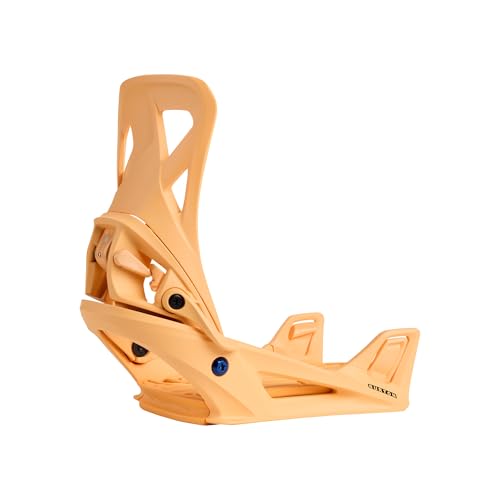
- ✓ Easy step-in system
- ✓ Plush cushioning
- ✓ Adjustable for comfort
- ✕ Pricey at $290
- ✕ Slightly bulky feel
| Baseplate | Single-component construction for reliable response and consistent feel |
| Mounting System | Re:Flex system compatible with all current snowboard mounting standards |
| Cushioning | FullBED cushioning for enhanced comfort and reduced fatigue |
| Connection System | Step On boot-to-binding connection with two toe points and one heel point |
| Adjustability | Zero forward lean hi-back and FLAD system for micro stance adjustments |
| Weight | Not explicitly specified; inferred to be lightweight due to Re:Flex technology |
The moment I clicked into these Burton Step On Re:Flex bindings, I immediately noticed how effortlessly secure the connection felt. That quick, two-toe, one-heel point system is a game-changer—no fuss, no fumbling, just instant confidence as I stepped in.
The FullBED cushioning is surprisingly plush, absorbing impacts and reducing fatigue even after hours on steep runs. It’s like standing on a cloud, but with the responsiveness you need for precise turns.
And with the trap-door design, accessing mounting hardware is a breeze, which saves time and hassle at the mountain.
The single-component baseplate delivers a consistent, solid feel across different terrains. The Re:Flex system also keeps the board’s flex natural, so it feels smooth whether you’re carving through powder or jibbing in the park.
Micro-adjustments via the FLAD system let me dial in my stance for a relaxed or aggressive ride, which I really appreciated.
What really stood out was the zero forward lean hi-back, giving a more laid-back stance when I wanted it, yet firm enough for quick response. It’s versatile enough for all-day riding, and the overall design just screams durability and quality.
Plus, knowing Burton’s commitment to sustainability adds a good vibe while I’m shredding.
Overall, these bindings blend comfort, security, and adjustability in a way that makes every run feel more controlled and enjoyable. If you’re after a setup that’s easy to use but still high-performance, these are a solid choice.
What Is a Snowboard Binding Stance and Why Is It Important?
According to the International Snowboard Federation (ISF), the stance can be categorized into regular (left foot forward) and goofy (right foot forward), with variations in angles and widths tailored to individual preference and riding style.
Key aspects of snowboard binding stance include the stance width, which is the distance between the bindings, and the angles of the bindings themselves. A wider stance can provide greater stability, particularly for tricks and jumps, while a narrower stance might allow for quicker turns and easier maneuverability. Binding angles are typically measured in degrees, with common setups being zero degrees (parallel to the board), positive angles (such as +15 degrees), or negative angles (like -15 degrees), each affecting how a rider engages with the board during turns and landings.
The importance of finding the best snowboard binding stance cannot be overstated as it significantly impacts a rider’s comfort and performance. A well-adjusted stance can enhance a rider’s ability to carve effectively, perform tricks, and maintain balance on various terrains. For instance, a beginner may benefit from a more neutral stance to facilitate learning, while experienced riders might experiment with angles to optimize their performance in specific styles, such as freestyle or alpine riding.
Statistics indicate that nearly 50% of snowboarders experience discomfort or performance issues due to improper stance settings. It is essential for riders to spend time experimenting with their stance to find what feels most natural and efficient for them. Additionally, many snowboarding resources recommend periodic adjustments based on evolving skill levels or changes in riding style, as this can lead to significant performance improvements.
To achieve the best snowboard binding stance, it is advisable to consider using tools such as stance width calculators or consulting with professionals at a local snowboard shop. This can ensure that the individual configurations align with body mechanics, promoting a more enjoyable and effective riding experience. Regularly revisiting and adjusting the stance as skills develop or as new equipment is acquired can also help maintain optimal performance on the slopes.
What Are the Different Types of Snowboard Binding Stances?
The different types of snowboard binding stances can significantly influence rider comfort, control, and performance.
- Regular Stance: This is when the rider has their left foot forward on the board, which is the most common stance.
- Goofy Stance: In this stance, the rider has their right foot forward, which is less common but preferred by some riders.
- Duck Stance: This is characterized by having both feet angled outward, allowing for versatile riding in either direction.
- Forward Stance: In this setup, both feet are angled forward, which may help with stability and control during aggressive riding.
- Neutral Stance: This stance usually features a slight angle on both feet, providing a balanced position for a variety of riding styles.
The Regular Stance is designed for riders who feel most comfortable leading with their left foot, providing a natural alignment for most downhill riding scenarios. It is preferred by the majority of snowboarders as it aligns well with the typical mountain terrain.
The Goofy Stance, on the other hand, caters to those who feel more stable with their right foot in front. While less common, it is equally valid and can provide a unique riding experience that some may find more intuitive.
The Duck Stance is particularly popular among freestyle riders because it allows for seamless transitions between regular and switch riding, making it ideal for tricks and park features. This stance promotes a wider base and enhances balance, which is vital for performing tricks.
A Forward Stance emphasizes a more aggressive riding style, often preferred by riders who focus on carving and speed. This stance can provide better control on steep descents but may limit the ability to ride switch effectively.
The Neutral Stance strikes a balance and is versatile enough for various styles, allowing riders to maneuver easily without favoring one direction. This stance is particularly useful for beginners who are still discovering their comfort zone on the board.
How Can I Determine If I Am Riding Regular or Goofy?
To determine whether you ride regular or goofy on a snowboard, you can consider several factors including your natural stance, footedness, and specific tests.
- Natural Stance: Assess which foot you naturally lead with when sliding on a flat surface, such as ice or a smooth floor. Most people will have a dominant foot that they instinctively place forward; if your left foot is in front, you are likely regular, while a right foot forward indicates a goofy stance.
- Footedness: Consider your dominant foot in other sports or activities, such as kicking a ball. If you kick with your right foot, you may find comfort riding goofy, whereas a left-footed kicker might prefer a regular stance.
- The Stance Test: A common test is to have someone gently push you from behind. The foot you step forward with to regain balance usually indicates your riding stance; stepping forward with your left foot suggests a regular stance, while stepping with your right foot suggests goofy.
- Snowboarding Experience: If you have been snowboarding before, recall which foot you placed in front when you first learned to ride. The stance you felt most comfortable with during your initial rides is likely the one that suits you best.
- Adjustable Bindings: If you have adjustable snowboard bindings, experiment by switching your stance from regular to goofy on the slopes. This firsthand experience can help you determine which stance feels more natural and allows for better control.
What Factors Should I Consider When Choosing My Snowboard Binding Stance?
When choosing your snowboard binding stance, several factors play a crucial role in optimizing your performance and comfort on the slopes.
- Stance Width: The distance between your bindings should match your shoulder width or slightly wider, which helps maintain balance and control. A wider stance can enhance stability, especially for freestyle riding, while a narrower stance can improve edge control for carving.
- Stance Angle: The angle at which your bindings are set can significantly affect your riding style; common setups include duck stance (both feet angled outward) for freestyle riders or a forward stance (front foot angled forward) for all-mountain and freeride. Adjusting these angles can help reduce strain on your knees and improve your overall comfort.
- Regular vs. Goofy Stance: Knowing whether you are regular (left foot forward) or goofy (right foot forward) is essential, as it dictates the orientation of your bindings. This preference usually stems from which foot you feel more comfortable leading when riding, so experimenting can help you find your natural stance.
- Riding Style: Your preferred riding style—whether it’s freestyle, all-mountain, or freeride—will impact your binding stance settings. Freestyle riders may prefer a more symmetrical stance for tricks, while freeriders might opt for a more forward stance for better control in powder and steep terrain.
- Boot Size: The size of your snowboard boots can also influence your binding stance; larger boots might need a wider stance to prevent toe and heel drag during turns. Make sure to account for your boot size when setting up your bindings to ensure optimal performance.
- Personal Comfort: Ultimately, your comfort is paramount; adjusting your stance to what feels right can make a significant difference in your riding experience. Take the time to experiment with different settings to find the perfect balance that allows you to ride confidently and with ease.
How Do My Height and Weight Impact My Snowboard Binding Stance?
Your height and weight significantly influence the best snowboard binding stance for optimal performance and comfort.
- Height: Taller individuals may benefit from a wider stance to maintain balance, while shorter individuals often do better with a narrower stance. A wider stance can provide more stability and leverage for turning, while a narrower stance allows for easier maneuverability.
- Weight: Heavier riders may require a stiffer board and tighter binding settings to effectively transfer energy and maintain control, whereas lighter riders might prefer a softer setup for a more forgiving ride. The weight can also affect the stance width, as heavier riders may need a wider stance to distribute their weight more evenly across the board.
- Foot Size: Larger feet can necessitate a wider stance to avoid toe drag during turns, while smaller feet may not face this issue. Proper alignment of bindings in relation to foot size ensures efficient energy transfer and reduces the risk of catching edges while riding.
- Riding Style: Different styles such as freestyle, all-mountain, or freeride also dictate stance preferences based on height and weight. Freestyle riders may opt for a more centered and narrow stance for tricks, while freeriders often prefer a wider stance for stability at high speeds.
What Role Does Riding Style Play in My Snowboard Binding Stance?
- Freestyle: Freestyle riders often prefer a wider stance with a slightly ducked-out setup, which allows for better balance during tricks and landings. This stance promotes a more relaxed position, making it easier to spin and maneuver while riding switch.
- All-Mountain: All-mountain riders typically adopt a stance that balances both comfort and versatility, allowing them to navigate various terrains effectively. A slight forward angle is common to enhance edge control while still being adaptable for both groomed runs and powder conditions.
- Freeride: Freeride enthusiasts generally favor a narrower stance with a more forward angle to maximize power and edge grip during descents. This configuration helps them maintain stability at high speeds and efficiently carve through challenging terrain, including steep runs and backcountry powder.
- Park: Riders focused on park features often use a symmetrical stance with equal angles for both bindings, promoting balance when executing tricks on rails and jumps. This stance allows for seamless transitions between riding regular and switch, crucial for park performance.
- Powder: For powder riding, a wider stance with a setback position is beneficial as it helps keep the rider’s weight centered over the board. This setup aids in floatation and maneuverability in deep snow, allowing for smoother turns and better control in variable conditions.
How Can I Experiment to Find My Ideal Snowboard Binding Stance?
To find your ideal snowboard binding stance, consider experimenting with the following factors:
- Stance Width: Adjusting the distance between your bindings can significantly affect your balance and control on the board.
- Stance Angles: The angle at which your bindings are set can influence your riding style and comfort level.
- Regular vs. Goofy Stance: Determining whether you ride with your left foot forward (regular) or right foot forward (goofy) is fundamental to your setup.
- Binding Position: The placement of your bindings relative to the board’s width can alter your leverage and response.
- Testing Different Setups: Taking time to ride in various configurations will help you identify what feels best for your style.
Stance Width: The stance width refers to how far apart your bindings are placed on the snowboard. A wider stance can provide greater stability and leverage for carving, while a narrower stance may enhance maneuverability and control, especially for beginners. Start with a shoulder-width stance and adjust based on your comfort and riding style.
Stance Angles: The stance angles are the degree to which your feet are turned on the board. Common angles include positive (front foot angled forward) and negative (back foot angled backward), with many riders opting for a duck stance (both feet angled outward). Experimenting with different angles helps find the optimal foot position that allows for maximum comfort and performance in turns and tricks.
Regular vs. Goofy Stance: Identifying whether you are a regular or goofy rider is essential as it dictates the primary direction in which you ride. Regular riders have their left foot forward, while goofy riders have their right foot forward. To determine your stance, try sliding on a slick surface to see which foot you naturally lead with.
Binding Position: The binding position refers to how far the bindings are set from the board’s centerline. Moving the bindings closer to the tail can enhance responsiveness and quick turns, while positioning them toward the nose can improve float in powder. Adjust this based on the terrain you primarily ride and your personal preference for balance.
Testing Different Setups: The best way to find your ideal snowboard binding stance is to test different configurations on snow. Spend time riding with varying widths, angles, and positions, noting how each change impacts your comfort, control, and performance. This hands-on approach allows you to make informed adjustments based on real experience rather than theory alone.
What Are the Benefits of Adjusting My Snowboard Binding Stance for Different Conditions?
A wider stance can significantly increase stability, particularly when riding in powder or rough conditions. This wider base helps distribute your weight more evenly, making it easier to maintain control and reducing the risk of catching an edge.
Comfort is crucial for an enjoyable day on the slopes. By adjusting your stance to better align with your natural body position, you can alleviate discomfort in your knees and ankles, allowing you to ride longer without fatigue.
Snowboarding terrain can vary greatly, from groomed runs to backcountry powder, and having the flexibility to adjust your stance can enhance your performance across different environments. A stance that works well for park riding may not be suitable for steep descents, so being adaptable is key.
Finally, your stance can be a reflection of your personal riding style. Whether you favor a more playful, freestyle approach or a serious, aggressive technique, fine-tuning your bindings can help you express your unique style on the mountain.
Related Post: