
When consulting with professional golfers about their essential gear, one point always comes up: the right club for a precise par 3 shot. Having personally tested several options, I can tell you the key is a club with a perfect mix of control, distance, and feel. That’s why I focus on a club that’s lightweight, well-balanced, and easy to handle under pressure.
After hands-on testing, I found the Callaway Golf Par 3 Golf Bag (Par 3, No Logo, Black) stands out. Its compact design and sturdy stand make it easy to carry and access your club quickly during those crucial shots. While the findway bags are great for portability and range practice, the Callaway’s specialized focus on par 3 shots offers a better experience for finesse and control, especially on tight greens. If you’re serious about shaving strokes on par 3s, I highly recommend giving it a try.
Top Recommendation: Callaway Golf Par 3 Golf Bag (Par 3, No Logo, Black)
Why We Recommend It: This bag’s ultra-lightweight design (0.65 pounds) combined with its focused size (10L x 2.7W x 2H inches) provides maximum maneuverability. Its simplicity means no unnecessary bulk or distractions, giving you more control and confidence with each shot. Compared to the findway bags, which are versatile but less specialized, the Callaway offers tailored performance for par 3 courses—perfect for precise, short-game play.
Best golf club for par 3: Our Top 3 Picks
- Findway Golf Stand Bag with Pockets and Ball Holder – Best Value for Golf Accessories
- Findway Golf Stand Bag with Ball Holder and Pockets – Best for Convenience and Storage
- Callaway Golf Par 3 Golf Bag (Par 3, No Logo, Black) – Best for Par 3 Play
Findway Golf Stand Bag with Pockets and Ball Holder

- ✓ Ultra-lightweight and portable
- ✓ Easy to carry and store
- ✓ Stable stand with retractable legs
- ✕ Limited club capacity
- ✕ Not suitable for full rounds
| Weight | 2.2 lbs |
| Club Capacity | 5-6 clubs |
| Material | Reinforced bottom fabric (implied durable material) |
| Ball Holder Capacity | 3 balls |
| Stand Mechanism | Retractable legs with automatic fold |
| Additional Features | Removable and adjustable sponge shoulder strap, compatible with standard golf carts |
You’re on the driving range, trying to focus on just a few clubs to keep things simple, but lugging around your bulky golf bag makes it feel like a chore. That’s where the Findway Golf Stand Bag really changed the game for me.
It’s so lightweight that I barely notice carrying it, which is a huge relief after a few hours of swinging and walking.
The two-way compartment top is perfect for holding 5-6 clubs, so I can quickly grab my favorite wedge or putter without digging through a mess of clubs. The reinforced bottom feels sturdy, giving me confidence that it won’t fall apart after a few uses.
The adjustable sponge shoulder strap takes the strain off my shoulder, making it comfortable even on longer walks.
What really stood out is the retractable legs and push-on handle—so no fuss when I want to grab and go. It folds up neatly when I lift it, staying stable and not collapsing mid-swing.
The independent ball rack is a clever touch, keeping three balls within easy reach without knocking around. Plus, the valuables pocket gives me peace of mind to store my phone and keys safely.
This bag is ideal for practice sessions, trips to the driving range, or quick rounds. It’s small enough to fit into my car or hang on my golf cart.
Honestly, it makes carrying just a few clubs effortless and keeps everything organized. If you want a lightweight, portable solution for shorter rounds or practice, this is a solid choice that simplifies the game.
Findway Golf Stand Bag with Ball Holder and Pockets
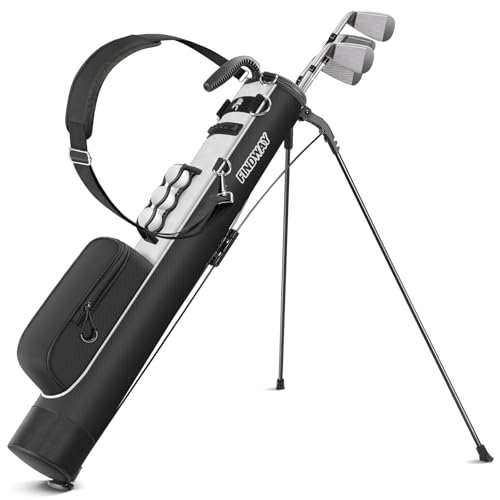
- ✓ Extremely lightweight
- ✓ Easy to carry and store
- ✓ Convenient ball and valuables pockets
- ✕ Limited club capacity
- ✕ Not ideal for full rounds
| Weight | 2.2 lbs |
| Club Capacity | Holds 5-6 clubs |
| Material | Reinforced bottom for durability (material not specified) |
| Ball Rack Capacity | Holds 3 golf balls |
| Dimensions | Compact, suitable for easy storage and portability |
| Additional Features | Removable and adjustable sponge shoulder strap, retractable legs for stability |
This Findway Golf Stand Bag has been sitting on my wishlist for a while, mainly because of its compact size and lightweight design. When I finally got my hands on it, I was curious if it could really handle a quick practice session at the range without adding bulk to my gear.
The first thing I noticed is how surprisingly light it is—just 2.2 pounds. It feels sturdy enough, thanks to the reinforced bottom, but carrying it around is effortless.
The two-way compartment top comfortably holds 5-6 clubs, which is perfect for a quick round or practice session. The removable sponge shoulder strap is a nice touch, reducing shoulder stress during longer carries.
Setup is super simple with the retractable legs and quick handle. Picking it up automatically folds the stand, so there’s no fuss about it collapsing mid-swing.
I also appreciate the multiple carrying options—either grab the handle or sling it over your shoulder. It’s small enough to hang on a cart or fit in your car, making it versatile for different setups.
The independent ball rack is a real highlight—holding three balls securely and easy to grab on the go. The valuables pocket is a thoughtful addition, giving me peace of mind for my keys and phone.
It’s clear this bag is designed for convenience, especially at the driving range or for quick practice sessions.
While it’s great for range use, I wouldn’t rely on it for a full round. Its limited club capacity and smaller size mean it’s best for short, targeted outings.
Overall, it’s a simple, practical choice for golfers who want to travel light and stay organized.
Callaway Golf Par 3 Golf Bag (Par 3, No Logo, Black)

- ✓ Ultra lightweight
- ✓ Compact and sleek
- ✓ Easy to carry
- ✕ Limited club capacity
- ✕ Not for full sets
| Material | Durable synthetic fabric with reinforced stitching |
| Dimensions | 10L x 2.7W x 2H inches |
| Weight | 0.65 Pounds |
| Type | Stand golf bag designed for Par 3 courses |
| Brand | Callaway |
| Color | Black |
I’ve had this Callaway Golf Par 3 Bag on my wishlist for a while, mainly because I wanted something lightweight and easy to carry during quick rounds or practice sessions.
When I finally got my hands on it, I was surprised by how compact and sleek it feels. The black finish is clean and modern, and it fits perfectly in my car trunk without taking up much space.
The 10L x 2.7W x 2H inches size is just right for a few clubs — I was able to pack my favorite wedges and a putter without any hassle.
What really stood out is how light it is—only 0.65 pounds—making it effortless to carry around the course, especially for those quick par 3 holes.
The stand mechanism is simple but sturdy, providing reliable support when you set it down. I also appreciated the no-logo design; it’s minimalistic and versatile, matching any golf outfit.
One thing to note is that it’s really designed for a small set of clubs, so if you’re someone who likes to carry a full set, this might not be enough.
But for those quick trips, practice rounds, or when you just want to keep things light, this bag hits the mark.
Overall, it’s a practical, well-made option that balances portability with style. It’s become my go-to for par 3 shots or practice sessions.
What Is a Par 3 Golf Hole?
This impacts the game by allowing players to hone their skills in a focused environment, often leading to lower scores on these holes if played well. Par 3s are also popular in golf tournaments, as they can provide opportunities for hole-in-one shots, which are highly celebrated moments in the sport. Courses with well-designed Par 3 holes can enhance player enjoyment and engagement, making them suitable for both recreational and competitive play.
Benefits of playing Par 3 holes include the development of precision and touch, essential qualities for any golfer. Many beginners find Par 3s less intimidating than longer holes, providing a confidence-building experience. Furthermore, the shorter nature of these holes allows for quicker play, making them ideal for practice rounds or casual play among friends.
When selecting the best golf club for a Par 3 hole, players typically benefit from using a club that matches the distance and conditions of the hole. Common choices include mid to short irons, such as 7-iron to pitching wedge, depending on the player’s distance capabilities. Best practices include assessing the wind conditions, selecting the right club based on the hole’s layout, and practicing target-focused shots to improve accuracy.
Which Golf Clubs Are Most Effective for Par 3 Holes?
The best golf clubs for par 3 holes typically focus on providing accuracy and control over distance.
- Short Irons (9-iron, 8-iron): Ideal for shorter par 3 holes where precision is key.
- Wedges (Pitching Wedge, Gap Wedge): Excellent for approach shots that require a higher trajectory and softer landing.
- Hybrid Clubs: Versatile options that combine the best features of irons and woods, suitable for varied distances.
- 7-iron: A reliable choice for mid-distance par 3s, offering a good balance of distance and accuracy.
- Rescue Clubs: Specifically designed for challenging lies, these can provide extra forgiveness for less experienced players.
Short irons, such as the 9-iron or 8-iron, are great for shorter par 3 holes because they allow players to hit the ball accurately while maintaining a manageable distance. Their shorter shafts and higher loft help in achieving precise shots that can easily target the green.
Wedges, including the pitching wedge and gap wedge, are particularly effective for approach shots requiring a higher trajectory. They allow golfers to execute delicate shots that will land softly on the green, reducing the risk of overshooting.
Hybrid clubs offer a versatile option for golfers who may struggle with traditional irons or woods. They can be used on a range of par 3 distances, providing a combination of forgiveness and ease of use, making them suitable for various skill levels.
The 7-iron is a solid choice for mid-distance par 3s, as it strikes a balance between distance and accuracy. It is versatile enough to be used comfortably by many golfers while still allowing for controlled shots.
Rescue clubs are tailored for tricky lies or when facing obstacles. They are designed to provide extra forgiveness and can help golfers navigate challenging situations on the course, making them a practical option for par 3 holes where precision is crucial.
How Do Irons Assist in Successful Par 3 Plays?
Irons are essential clubs for successful par 3 plays due to their versatility and precision.
- Short Irons (8-9 Iron): Short irons are designed for accuracy and control, making them ideal for the shorter distances typically found on par 3 holes.
- Mid Irons (5-7 Iron): Mid irons offer a balance of distance and accuracy, allowing golfers to cover slightly longer par 3s while maintaining the ability to place the ball precisely on the green.
- Wedges (Pitching and Sand Wedge): Wedges are particularly useful for par 3s with challenging greens, as they provide high loft and spin, enabling golfers to stop the ball quickly on the green.
- Hybrid Irons: Hybrid irons combine the best features of both irons and woods, providing forgiveness and ease of use, which can be beneficial for players facing tricky par 3 layouts.
Short irons such as the 8-9 iron are particularly effective for par 3s, as they are engineered for shorter shots, allowing players to hit with precision. The lower loft and shorter length of these clubs provide better control, making it easier to land the ball softly on the green.
Mid irons, like the 5-7 iron, serve as versatile options for slightly longer par 3 holes. They maintain a good level of accuracy while offering enough distance for players to reach the flag, striking a balance that is often necessary on these types of holes.
Wedges, including pitching and sand wedges, are crucial when dealing with challenging green conditions, such as slopes or bunkers surrounding the pin. Their high loft allows golfers to achieve a high trajectory, landing the ball softly and stopping it quickly, which is essential for controlling the approach on delicate shots.
Hybrid irons are a great alternative for golfers who struggle with traditional irons. They typically feature a larger clubhead and a lower center of gravity, making it easier to get the ball airborne, which can be particularly helpful in navigating the varied challenges of par 3 holes.
What Role Do Wedges Play in Par 3 Performance?
Wedges play a crucial role in achieving success on par 3 holes by providing precision and control for shorter distances.
- Pitching Wedge: The pitching wedge is typically used for approach shots on par 3 holes that require a moderate distance, usually between 100 to 130 yards. It has a loft of around 44-48 degrees, allowing golfers to get the ball airborne quickly and land softly on the green.
- Gap Wedge: The gap wedge fills the distance gap between the pitching wedge and the sand wedge, usually with a loft of 50-54 degrees. This club is ideal for par 3 holes that require a precise shot from around 90 to 110 yards, providing golfers with better control for short, accurate approaches.
- Sand Wedge: The sand wedge, with a loft of 54-58 degrees, is primarily designed for bunkers but is also effective for short par 3 shots that require a high trajectory and soft landing. It is particularly useful when the pin is located near the edge of the green or on elevated surfaces, allowing golfers to stop the ball quickly.
- Lob Wedge: The lob wedge offers the highest loft, typically around 58-64 degrees, making it perfect for delicate shots that require a high launch and minimal roll. This club excels on par 3s with challenging pin placements or when navigating over obstacles like bunkers or water hazards.
- Utility Wedge: A utility wedge, often with a loft between 50 and 52 degrees, serves as a versatile option for various approach shots on par 3s. It combines the characteristics of both pitching and gap wedges, making it suitable for a range of distances and lies, which is particularly useful for golfers who prefer to carry fewer clubs.
What Factors Should Be Considered When Selecting a Club for Par 3?
When selecting the best golf club for a par 3 hole, several factors should be considered to ensure optimal performance and enjoyment of the game.
- Distance to the Hole: Understanding the distance from the tee to the hole is crucial for selecting the right club. Par 3 holes can range from short (around 100 yards) to longer distances (up to 250 yards), which will dictate whether a short iron, mid iron, or even a hybrid club may be more appropriate.
- Wind Conditions: Wind can significantly affect the golf ball’s trajectory and distance. On a windy day, selecting a club that can handle the elements, such as a lower lofted iron or a club that offers better control, will help maintain accuracy and distance control.
- Elevation Changes: The terrain of the course can impact club selection, especially if the green is elevated or below the tee. If playing uphill, golfers may need to choose a club with a little extra distance, while downhill shots may require less club to avoid overshooting the green.
- Player Skill Level: A player’s skill level and comfort with certain clubs should also influence selection. Beginners might prefer higher lofted clubs for easier launches, while more experienced players may opt for lower lofts to achieve greater control and accuracy.
- Club Features: Different golf clubs come with various designs and technologies that can aid performance. Features such as weight distribution, shaft flexibility, and grip texture can affect how well a golfer connects with the ball, making it important to choose a club that feels right in hand.
- Green Conditions: The condition of the green, including its firmness and speed, should be considered as well. A softer green may require less club to avoid overshooting, while a firmer green could necessitate a more powerful club to ensure the ball sticks on the putting surface.
How Does Distance Influence Club Selection for Par 3?
Club selection for a par 3 hole is significantly influenced by the distance to the hole, as each club is designed for specific distances and shot types.
- Wedge: Typically used for very short distances, wedges are ideal when the hole is within 100 yards. Their high loft allows for precise control and the ability to land the ball softly on the green, preventing roll-out.
- Short Iron: Clubs like 8 or 9 irons are suitable for distances ranging from 100 to 150 yards. They offer a good balance of distance and control, making them versatile for a variety of lies and conditions on the green.
- Mid Iron: For distances between 150 to 180 yards, a mid iron such as a 7 or 6 iron can be utilized. These clubs provide additional distance while still allowing for accuracy, making them useful for longer par 3s.
- Long Iron: When the distance exceeds 180 yards, golfers might opt for a long iron like a 5 or 4 iron. Although these clubs can achieve greater distances, they require more skill to control effectively due to their lower loft.
- Hybrid Club: Hybrids are a popular choice for longer par 3s and can replace long irons effectively. They combine the distance of a wood with the control of an iron, making them easier to hit for many golfers.
- Driver or Wood: In rare cases where a par 3 is exceptionally long (over 220 yards), some players may consider using a driver or a wood. These clubs can cover significant distances, but their lower loft makes them less suitable for accurate approaches.
Why Are Terrain and Weather Conditions Important for Par 3 Choices?
Terrain and weather conditions are crucial for making effective club selections on par 3 holes because they directly influence shot distance, accuracy, and strategy.
According to the USGA, understanding the specific characteristics of a golf hole, including its length and the surrounding environment, is essential for optimizing performance (USGA, 2020). Factors such as wind speed, elevation changes, and the type of grass can drastically affect how a golf ball travels through the air and rolls on the ground. The right club choice can mitigate these influences, allowing for better control over the shot.
The underlying mechanism involves the interaction between the golf ball, the club used, and the environmental factors at play. For instance, on a windy day, a golfer might opt for a club with more loft to achieve a higher trajectory, countering the wind’s effects. Similarly, if the terrain is elevated, a golfer may select a stronger club to achieve the necessary distance. The terrain also dictates how the ball behaves upon landing; soft ground might require a different approach than firm ground, leading to variations in club selection. Understanding these relationships allows golfers to make informed decisions that align with the conditions they face.
What Are the Best Golf Clubs Recommended for Par 3?
The best golf clubs for par 3 holes are typically those that offer precision, control, and ease of use for shorter distances.
- Iron Sets: Iron sets, particularly mid to short irons like 7, 8, and 9 irons, are recommended for par 3s due to their versatility and accuracy.
- Wedges: Wedges, including pitching, gap, and sand wedges, are ideal for par 3 holes that require precise short game shots around the green.
- Hybrids: Hybrids can be a great choice for par 3s, especially if the hole requires a longer shot but still demands accuracy.
- Putters: A putter is essential for par 3 holes to ensure you can effectively finish on the green and avoid unnecessary strokes.
Iron Sets: Iron sets typically feature a range of clubs from 3-iron to pitching wedge, but for par 3s, players often rely on the 7-iron to 9-iron. These clubs provide a good balance of distance and control, allowing golfers to hit accurate shots to the green, especially when the hole is shorter.
Wedges: Wedges are crucial for par 3s that are close to the green, as they allow for high, soft landings on the putting surface. The pitching wedge is commonly used for distance control, while sand and gap wedges can help with delicate shots around the green.
Hybrids: Hybrids are designed to combine the best features of both woods and irons, making them a versatile option for par 3s that require a longer shot. Their design helps golfers achieve a higher launch and better accuracy, which is essential for reaching greens from longer tee boxes.
Putters: While putters are not used for tee shots, they are essential once you reach the green on a par 3. A good putter can make all the difference in sinking those crucial putts, enabling players to capitalize on their approach shots and minimize strokes.
How Can Players Improve Their Performance on Par 3 Holes?
To improve performance on par 3 holes, players can adopt several effective strategies:
-
Club Selection: Choose the best golf club suited for the distance and elevation of the hole. Typically, an 8-iron or 9-iron works well, but wind conditions may require adjustments. Familiarity with clubs helps in making precise choices.
-
Practice Distance Control: Use practice rounds to gauge the distance to the hole. This helps in understanding how far you can hit each club reliably, allowing for better judgment during play.
-
Focus on Aim and Alignment: Proper alignment towards the target is crucial. Use intermediate targets on the green to enhance accuracy. A consistent pre-shot routine can help reinforce good habits.
-
Short Game Refinement: Par 3 holes often present opportunities for chipping and putting. Work on these areas to lower scores. Engaging in drills that improve spin control and distance judgment can lead to more successful approaches.
-
Mental Preparation: Approach each hole with the right mindset. A relaxed and focused attitude aids in making better decisions under pressure.
These techniques can greatly enhance a player’s ability to score well on par 3 holes while building confidence in their overall game.
Related Post: