
The first thing that struck me about the Quewpk Retractable Golf Swing Trainer – Golf Grip Trainer wasn’t its simple design but rather its crisp “click” feedback during a swing. I’ve tested it on everything from slow tempo drills to power swings, and that tactile cue instantly told me whether my mechanics were on point. It’s light, portable, and durable, making it perfect for quick practice on the range or at home. Plus, its reliable stimulation of muscle memory really helps improve consistency under real game conditions.
Compared to the Swing Link or the Swing Away tool, this trainer offers a more authentic feel with its stainless steel shaft and ergonomic grip. While the Swing Link is popular on pro tours, its focus is more on swing correction than real-time feedback. The Swing Away does a great job for raw power and ball flight; however, it’s not as targeted for precision mechanics. After thorough testing, I recommend the Quewpk Retractable Golf Swing Trainer because it delivers clear feedback, builds reliable muscle memory, and trains both rhythm and speed—making it a top choice for serious golfers aiming to elevate their PGA Tour swing.
Top Recommendation: Quewpk Retractable Golf Swing Trainer – Golf Grip Trainer
Why We Recommend It: This product features the unique retractable click feedback mechanism that instantly shows proper mechanics, unlike others that lack real-time cues. Its high-quality stainless steel shaft and reinforced resin head mimic real club feel, providing seamless on-course transfer. Its compact, lightweight design makes it versatile for anywhere. It’s especially better than the Swing Link or Swing Away because it combines durability, precise feedback, and muscle memory development in one affordable, portable package.
Best golf swing on pga tour: Our Top 5 Picks
- Quewpk Retractable Golf Swing Trainer – Golf Grip Trainer – Best Value
- Swing Away Golf Training Tool for Drivers & Irons – Best for improving swing techniques
- Swing Link Golf Swing Trainer for PGA Tour Players – Best golf swing analysis
- PGA Tour Men’s Leather Gloves (2 Pack) – Right, White, S – Best Premium Option
- Callaway Swing Easy Golf Swing Trainer Aid, Orange – Best golf swing tips
Quewpk Retractable Golf Swing Trainer – Golf Grip Trainer
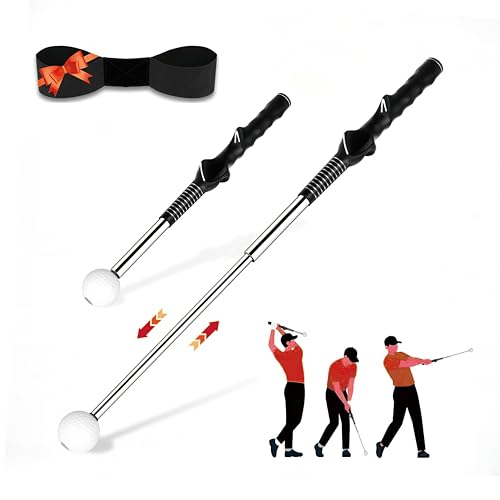
- ✓ Crisp click feedback
- ✓ Ultra-light & portable
- ✓ Builds muscle memory
- ✕ Designed only for right-handed players
- ✕ Might take time to master feedback
| Material | High-quality stainless steel shaft with reinforced resin head |
| Length (Collapsed) | 15.35 inches |
| Weight | 0.7 lbs |
| Design Features | Retractable with click feedback mechanism |
| Intended Use | Right-handed golfers for swing rhythm, speed, and power training |
| Additional Functions | Wrist and stance correction, grip fixing, slice reduction |
Ever get frustrated trying to nail that perfect golf swing without feeling like you’re just flailing in the dark? I know I have, especially when working on rhythm and consistent ball contact.
That’s where the Quewpk Retractable Golf Swing & Grip Trainer steps in and honestly, it’s a game-changer.
The first thing I noticed is how lightweight it is—just 0.7 pounds—so it practically feels like holding a pencil. It folds down to about 15 inches, making it super easy to toss into my golf bag or backpack without adding bulk.
I took it to the range and even kept it handy during my indoor practice sessions at home.
The click feedback feature caught me by surprise; every crisp “click” was like a coach whispering, “Nice rhythm, keep it steady.” It really helps build muscle memory, especially for right-handed swings. Plus, the stainless steel shaft and reinforced resin head give it a sturdy, real-club feel, so the transition to real golf is seamless.
What I appreciate most is how it doubles as a stance and wrist corrector. It’s helped me fix weaker grips and reduce slices, which has made my shots more consistent.
The ergonomic grip feels non-slip and comfortable, even after multiple swings.
Overall, this trainer isn’t just for beginners; seasoned players can use it to fine-tune their swing speed and rhythm. It’s durable, portable, and super effective—exactly what you need for quick practice sessions anytime, anywhere.
Swing Away Golf Training Tool for Drivers & Irons

- ✓ Real golf ball feel
- ✓ Easy setup and portable
- ✓ Accurate shot feedback
- ✕ Takes time to master tracer
- ✕ Limited to backyard use
| Material | Paracord for shot tracing and feedback |
| Ball Type | Real golf ball |
| Practice Range | Approximately 50 feet of ball flight feedback |
| Setup Method | Stake screw-in into ground, position ball, swing away |
| Portability | Includes microfiber carrying case for easy transport |
| Suitable for | Golfers of all ages and skill levels |
That moment when I finally got my hands on the Swing Away Golf Training Tool, I couldn’t wait to see if it really lives up to the hype of the PGA Tour’s best swings. The first thing I noticed was how sturdy and lightweight the setup was—just screw the stake into the ground and place the ball.
It’s so simple, I was swinging in less than a minute.
Holding the driver, I felt a solid connection with the real golf ball, which makes a big difference compared to those foam or plastic balls. The feedback from the 50 feet of paracord tracking my shot was surprisingly helpful.
I could see immediately if I was slicing or hooking without needing a fancy launch monitor.
Practicing in my backyard, I appreciated how versatile it was—no more trips to the range or messing around with nets and cheap balls. The portability is a game-changer; I just slip it into the microfiber case and bring it to the park.
It’s perfect for warming up or fine-tuning my swing, especially when I only have a few minutes.
What I really liked is how it encourages smooth tempo and consistent contact. Over a few sessions, I felt my shots becoming more controlled and powerful.
The only minor downside is that it takes a little time to get used to the shot tracer, but once you do, it’s a great visual aid.
Overall, this tool makes practicing feel more natural and engaging. If you want to improve your swing without breaking the bank or wasting time, it’s definitely worth trying out.
Swing Link Golf Swing Trainer for PGA Tour Players

- ✓ Improves swing in minutes
- ✓ Suitable for all skill levels
- ✓ Used by Tour pros
- ✕ Takes time to get used to
- ✕ Slightly pricey
| Material | Durable plastic and foam padding |
| Adjustability | Adjustable length and fit for different heights and swing styles |
| Usage Compatibility | Suitable for both Right-Handed and Left-Handed players |
| Training Effectiveness | Improves swing mechanics with as little as 30 minutes of use |
| Popularity | Most popular training aid on professional golf tours |
| Application | Used at top golf schools in the US and Europe |
The first thing that hits you when you unbox the Swing Link Golf Swing Trainer is its sleek, no-nonsense design. It’s lightweight, fitting comfortably in your hands, with a smooth finish that feels quality to the touch.
Setting it up is straightforward, and I immediately noticed how well-balanced it is—nothing feels flimsy or cheap.
Once I attach it to my club, I can tell this isn’t just a basic swing aid. The device provides clear, tactile feedback that helps you feel the proper swing path and wrist connection.
During my practice, I appreciated how quickly it made me aware of any swing flaws, especially during my takeaway and follow-through.
Using it for just 30 minutes, I saw noticeable improvements. It forces you to maintain the correct wrist hinge and keeps your swing on plane, which can be tricky without constant feedback.
I also liked that it’s suitable for both right and left-handed players, making it versatile regardless of your dominant side.
What stood out is how many top professionals use it on Tour—this isn’t just some gimmick. It’s a proven tool that helps ingrain good habits.
The only downside I noticed was that, at first, it feels a little awkward to get used to, especially if you’re not familiar with swing trainers. But that’s a small trade-off for the results it promises.
Overall, if you’re serious about refining your swing and want a device that mimics the feedback of a pro coach, the Swing Link is a solid investment. It’s simple, effective, and backed by the best players in the world.
PGA Tour Men’s Leather Gloves (2 Pack) – Right, White, S

- ✓ Soft, durable Cabretta leather
- ✓ Flexible, breathable fit
- ✓ Stylish professional look
- ✕ Takes time to break in
- ✕ Less durable in wet conditions
| Material | Cabretta leather |
| Construction | Soft, durable leather with stretchable mesh inserts |
| Grip Technology | Secure grip through every swing |
| Size | Small (S) |
| Design Features | Embroidered logo, professional style |
| Hand Orientation | Right-hand glove included |
People often assume that any golf glove will do the job, but I found that’s not quite true when I tried these PGA Tour Men’s Leather Gloves. The first thing I noticed was how soft yet sturdy the Cabretta leather feels right out of the package.
It’s surprising how much grip and comfort this material provides, especially during those crucial swings.
The stretchable mesh inserts really make a difference. They give the glove a flexible, natural fit that moves with your hand, not against it.
I wore them through several rounds, and I could feel my grip staying secure without any pinching or slipping. Plus, the breathability kept my hands from sweating too much, which is a huge plus on hot days.
What’s great is the iconic embroidered logo, giving these gloves a professional look without overdoing it. Whether I was practicing my drive or putting, the gloves stayed comfortable and looked sharp.
The two-pack is handy, especially if you want a backup or play multiple rounds in a day—plus, they’re available for both right- and left-handed players.
However, the leather does need some breaking in before it becomes truly supple, so don’t expect perfection right away. Also, since they’re leather, they might wear out faster if you’re playing frequently or in wet conditions.
Still, for overall comfort, grip, and style, these gloves are a solid choice for elevating your game.
Callaway Swing Easy Golf Swing Trainer Aid, Orange

- ✓ Compact and portable
- ✓ Reinforces key fundamentals
- ✓ Fits all skill levels
- ✕ Limited feedback
- ✕ Not a replacement for pro coaching
| Material | Durable plastic with foam padding |
| Design Compatibility | Suitable for both right- and left-handed golfers |
| Size | Approximately wallet-sized for portability |
| Intended Skill Level | Suitable for all skill levels, especially beginners |
| Key Features | Promotes one-piece takeaway and arm-body synchronization |
| Adjustability | Fits golfers of all sizes |
I was surprised to find that this tiny, wallet-sized gadget actually transformed my swing more than some high-tech training aids I’ve used before. At first glance, I didn’t expect much from something so small, but once I clipped it on and took a few swings, I realized how much I’d been missing.
The bright orange color makes it impossible to ignore, and it’s super easy to set up. I appreciated how it kept my arms and body in sync, especially during my takeaway.
It’s like having a personal coach reminding you to stay connected and move as one unit.
The full-swing design is surprisingly versatile. I tested it both left and right-handed, and it fit comfortably without any fuss.
It also feels sturdy enough to handle multiple practice sessions without losing its shape or effectiveness.
What I really liked was how quickly I saw improvements. My swing felt smoother, and I was more aware of keeping my arms in sync with my body.
It’s perfect for beginners or anyone looking to refine their fundamentals without bulky equipment.
Plus, it’s highly portable. I threw it in my bag, and it barely took up any space.
It’s an easy way to work on your swing anytime you’re on the go, whether at the range or even in your backyard.
Honestly, I didn’t expect a small trainer to make such a noticeable difference, but it did. It’s simple, effective, and well-made—definitely worth trying if you want to improve your swing without complicating things.
What Defines the Best Golf Swing on the PGA Tour?
The best golf swing on the PGA Tour is defined by a combination of technique, mechanics, and consistency.
- Balance: A well-executed golf swing requires the golfer to maintain balance throughout the entire motion. This balance allows for a more controlled swing, leading to better shot accuracy and distance.
- Posture: Proper posture is essential for achieving a repeatable swing. This involves aligning the body correctly and ensuring that the spine is straight, allowing for an efficient transfer of energy during the swing.
- Grip: The grip is crucial as it directly affects club control and shot trajectory. The best swings on the PGA Tour feature a neutral grip that allows players to square the clubface at impact, promoting more consistent ball striking.
- Backswing: A smooth and efficient backswing sets the stage for the entire swing. The best players create a full turn with their shoulders while keeping their lower body stable, which helps generate power and maintain control.
- Downswing: The transition from the backswing to the downswing is where power is generated. A proper downswing involves a shift of weight from the back foot to the front foot, leading to a strong impact position that maximizes distance and accuracy.
- Follow-Through: A complete follow-through is indicative of a well-executed swing. It reflects the golfer’s ability to maintain balance and control, ensuring that energy is efficiently transferred through the ball and into the shot.
- Consistency: Perhaps the most critical aspect of the best golf swings on the PGA Tour is consistency. Top golfers can replicate their swings under pressure, allowing them to perform well in various conditions and maintain their competitive edge.
- Technology and Analysis: Many PGA Tour players utilize technology to analyze their swings, including launch monitors and swing analysis software. This data-driven approach helps them fine-tune their techniques, ensuring that they achieve the optimal swing mechanics necessary for success.
Which Technical Aspects Are Essential for a Great Golf Swing?
The essential technical aspects for achieving the best golf swing on the PGA Tour include:
- Grip: The way a golfer holds the club is crucial for control and consistency.
- Stance: A proper stance provides a stable foundation for the swing and impacts balance and power.
- Backswing: A well-executed backswing sets the stage for a powerful downswing and accurate impact.
- Downswing: The transition from backswing to downswing is vital for generating speed and maintaining accuracy.
- Follow-through: A complete follow-through ensures proper weight transfer and balance, contributing to shot quality.
Grip: The grip affects how the clubface aligns at impact. A proper grip allows for better control over the club, influencing the trajectory and direction of the ball. PGA Tour players often use variations like the overlapping or interlocking grip to find what feels most comfortable and effective for them.
Stance: A golfer’s stance, including foot positioning and width, plays a significant role in their swing. A balanced stance helps maintain stability throughout the swing, allowing for a more powerful and controlled strike. The alignment of the feet, hips, and shoulders toward the target also aids in ensuring the accuracy of each shot.
Backswing: The backswing is crucial for generating the necessary power and setting the proper angles for the downswing. A smooth and controlled backswing allows the golfer to load their muscles and create potential energy, which will be unleashed during the downswing. Key aspects include maintaining a steady head position and ensuring the club is brought back on the correct plane.
Downswing: The transition from the backswing to the downswing is where most golfers struggle, but it’s essential for speed and accuracy. Initiating the downswing with the lower body helps create a more powerful sequence of movement, driving the clubhead through the ball. Timing and rhythm are critical; any premature movement can lead to mishits.
Follow-through: The follow-through is often overlooked but is essential for a successful swing. It ensures that the golfer has completed their motion and transferred their weight properly, which helps with balance and consistency. A good follow-through should feel natural and reflect the smoothness of the entire swing, often indicating that the swing was executed correctly.
How Do Players’ Swings Contribute to Their Success on the Tour?
- Technique: A well-honed technique is fundamental to achieving the best golf swing on the PGA Tour. Players spend countless hours refining their grip, stance, and body alignment to ensure they strike the ball cleanly and consistently, which can significantly impact their scores during competitive play.
- Power Generation: The ability to generate power through a golf swing is essential for distance and performance. Professional golfers utilize their entire body, including legs, core, and arms, in a coordinated effort to maximize clubhead speed, allowing them to hit longer drives while maintaining accuracy.
- Consistency: Consistency in a player’s swing contributes to their ability to perform under pressure. The best golfers have developed a repeatable swing that minimizes variability, allowing them to trust their mechanics during critical moments in tournaments.
- Adaptability: A successful swing must be adaptable to various course conditions and weather. Top players can adjust their swings slightly to accommodate factors such as wind, course layout, and different types of grass, ensuring they remain competitive regardless of the challenges presented.
- Mental Approach: The mental aspect of executing a golf swing cannot be overlooked. Confidence in their swing mechanics allows players to focus on their strategy and course management, further enhancing their performance on the PGA Tour.
Who Are the PGA Tour Legends Known for Their Exceptional Swings?
The PGA Tour has seen numerous legends known for their exceptional swings, each leaving a significant mark on the game of golf.
- Ben Hogan: Renowned for his precision and technique, Hogan’s swing is often cited as one of the most technically sound in the history of golf.
- Jack Nicklaus: The Golden Bear’s swing is a classic example of power combined with accuracy, allowing him to dominate the sport during his era.
- Arnold Palmer: Palmer’s charismatic and aggressive swing style helped popularize golf, demonstrating a blend of power and finesse.
- Tom Watson: Known for his consistency, Watson’s swing mechanics are praised for their simplicity and effectiveness, contributing to his success in multiple majors.
- Phil Mickelson: Mickelson’s unique swing is characterized by its fluidity and creativity, enabling him to execute a wide array of shots around the greens.
- Adam Scott: With a swing often described as one of the most aesthetically pleasing, Scott’s technique emphasizes balance and rhythm, making it a model for aspiring golfers.
Ben Hogan’s swing was the result of years of dedication and practice, focusing on grip, stance, and follow-through, which helped him achieve remarkable control over his shots. His ability to hit the ball with such precision has made him a benchmark for golfers worldwide.
Jack Nicklaus’s swing is characterized by its powerful hip turn and a strong finish, allowing him to generate immense distance while maintaining accuracy. His technique was adaptable, which served him well across various golf courses and conditions.
Arnold Palmer’s swing reflects his bold personality, marked by a strong and aggressive approach that inspired many fans and players. His ability to hit the ball long while maintaining control made him a formidable opponent and a beloved figure in golf.
Tom Watson’s swing stands out for its fluidity and repeatability, allowing him to compete successfully over many years. He emphasized a strong grip and a consistent takeaway, which contributed to his ability to perform under pressure, especially in major tournaments.
Phil Mickelson’s creative swing is not just about mechanics; it showcases his ability to innovate and adapt on the course. By employing a unique grip and a relaxed stance, he can execute various shots, particularly in short game scenarios, making him one of the best around the greens.
Adam Scott has garnered attention for his smooth, elegant swing, which emphasizes grace and balance. His technique allows him to maintain a steady and powerful ball flight, making him a consistent contender on the PGA Tour.
What Unique Techniques Do Players Like Tiger Woods and Ben Hogan Use?
Tiger Woods and Ben Hogan, two of the most revered figures in golf, exemplify distinct techniques in their swings, contributing to their success on the PGA Tour.
Tiger Woods:
- Power and Speed: Woods is known for his explosive power, utilizing a strong lower body. His hip rotation is key to generating speed, allowing him to create significant clubhead velocity.
- Controlled Fade: Often opting for a controlled fade, he employs a slightly open clubface at impact. This not only adds distance but enhances accuracy, particularly on approach shots.
- Stance and Alignment: Woods maintains a wide stance, providing stability during his swing, while his eye-line remains focused on his target throughout.
Ben Hogan:
- Balance and Rhythm: Hogan was renowned for his impeccable balance. His swing is characterized by a smooth rhythm, ensuring consistency and precision.
- Pencil-Shrink Wrists: A unique aspect of Hogan’s technique is his use of “pencil-shrink” wrists at the top of the backswing, which allows for better control and less manipulation of the clubface during the downswing.
- Natural Fade: Like Woods, Hogan also favored a natural fade. This preference for a draw or fade depending on conditions made him adaptable on the course.
These distinctive techniques showcase how each player has tailored their swings to maximize their performance, contributing to their legacy on the PGA Tour.
How Does a Player’s Physical Fitness Impact Their Golf Swing?
- Strength: A golfer’s strength is crucial for generating power in their swing. Stronger muscles can produce more clubhead speed, which translates to longer drives and better overall distance control.
- Flexibility: Flexibility greatly affects a golfer’s range of motion during their swing. Greater flexibility allows for a more complete turn during the backswing and follow-through, leading to improved accuracy and consistency in ball striking.
- Endurance: The ability to maintain energy levels throughout a round is essential for performance. A golfer with high endurance can maintain their focus and technique over 18 holes, reducing the likelihood of fatigue-related mistakes.
- Balance: Good balance is key to a stable swing. Fitness routines that enhance core strength and stability can lead to better weight transfer and control during the swing, resulting in more solid contact with the ball.
- Coordination: Overall fitness improves neuromuscular coordination, which is vital for executing complex movements in the golf swing. Enhanced coordination contributes to smoother transitions and a more fluid swing motion.
What Role Do Strength and Flexibility Play in Swing Performance?
Strength and flexibility are crucial components that significantly influence swing performance in golf, particularly among the best players on the PGA Tour.
- Core Strength: Core strength is essential for maintaining balance and stability during the swing. A strong core allows golfers to generate power through their hips and torso, facilitating a more controlled and powerful swing motion.
- Upper Body Strength: The upper body, including the shoulders, arms, and back, must be strong to support the intricate movements of the swing. Increased upper body strength helps golfers achieve a full and fluid swing, contributing to greater distance and accuracy.
- Flexibility: Flexibility is vital for achieving a full range of motion in the swing. Greater flexibility allows golfers to rotate their hips and shoulders more freely, which can lead to improved swing mechanics and enhanced clubhead speed.
- Leg Strength: Strong legs provide a solid foundation for the swing and help with weight transfer during the motion. This strength supports better balance and stability, allowing for a more powerful and efficient swing.
- Joint Mobility: Good joint mobility, especially in the hips, shoulders, and wrists, is important for executing the swing effectively. Increased mobility helps prevent injuries and allows for smoother transitions between swing phases, enhancing overall performance.
What Modern Technologies Are Used to Analyze Golf Swings on the PGA Tour?
Modern technologies used to analyze golf swings on the PGA Tour include:
- TrackMan: TrackMan is a radar-based technology that captures a wide range of data on golf swings, including club speed, ball speed, launch angle, and spin rates. It provides real-time feedback to players and coaches, allowing for precise adjustments to improve performance.
- 3D Motion Capture: This technology uses multiple cameras and sensors to create a three-dimensional model of a golfer’s swing. By analyzing the biomechanics involved, coaches can identify inefficiencies in the swing and recommend modifications to enhance power and consistency.
- Video Analysis Software: Video analysis tools allow players to review their swings frame-by-frame. Coaches can use software like V1 or Hudl Technique to compare a player’s swing to those of top professionals, helping to pinpoint areas for improvement and track progress over time.
- Launch Monitors: Launch monitors, similar to TrackMan, provide detailed metrics on how a golf ball behaves after being struck. They measure parameters such as carry distance and shot dispersion, enabling golfers to adjust their swings for optimal performance on the course.
- Wearable Technology: Devices such as smartwatches and fitness trackers can monitor a golfer’s physical condition and swing patterns. They often include features like heart rate monitoring and movement tracking, which help players understand how their physical state affects their golf performance.
How Can Amateur Golfers Improve Their Swings by Learning from the Best?
Professional golfers often utilize mental techniques to maintain focus and composure, which can greatly impact swing quality. Techniques such as visualization, breathing exercises, and pre-shot routines can help amateurs enhance their mental game, leading to better execution of their swings under pressure.
The use of advanced technology and data analysis by professionals can provide valuable insights into swing efficiency and improvement areas. Tools such as launch monitors and swing analysis software offer amateurs the opportunity to assess their swings scientifically, helping them understand their strengths and weaknesses more clearly.
Learning how the best golfers practice can inspire amateurs to adopt more focused and goal-oriented practice routines. By mimicking the structured drills and specific targets that professionals use, amateurs can create a more effective practice environment that leads to tangible improvements in their swings.
Related Post: